What Is CPC and CPM in Digital Marketing?
A clear, practical breakdown of the two most common advertising pricing models, how each one works, and which one fits your campaign goals.
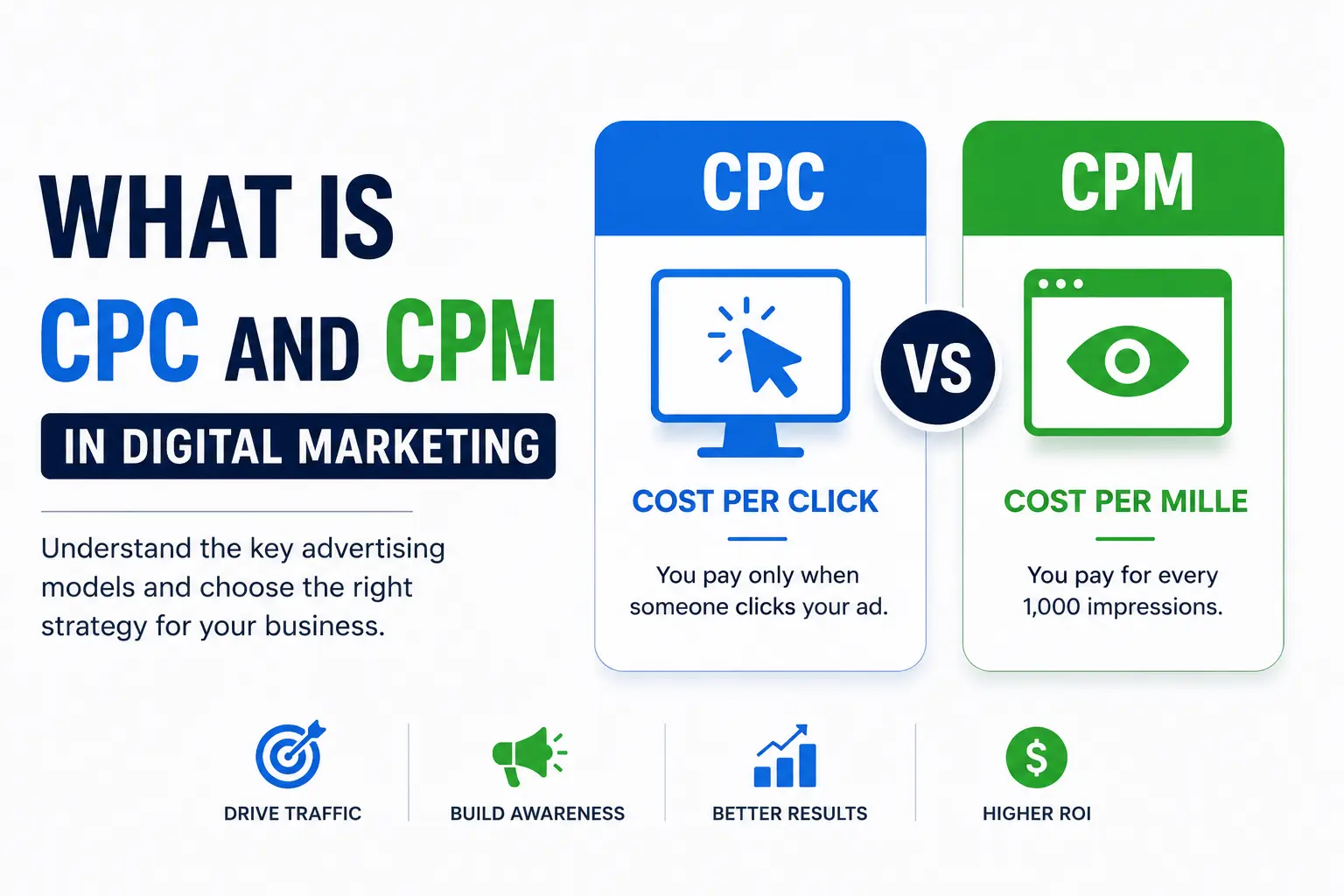
What is CPC and CPM in digital marketing? They’re the two most widely used pricing models for online advertising, and choosing the right one can make or break your campaign’s return on investment. CPC (Cost Per Click) charges you only when someone clicks your ad, while CPM (Cost Per Mille) charges you for every 1,000 times your ad is shown, whether anyone clicks it or not.
Both models power everything from Google Search ads to display banners and video pre-rolls, but they’re built for different goals. This guide breaks down how each one works, when to use them, and how to decide which fits your next campaign.
What Is CPC (Cost Per Click)?
CPC stands for Cost Per Click. It’s a pricing model where advertisers pay only when a user actually clicks on their ad. Instead of paying for visibility alone, you’re paying for direct engagement, which makes CPC a favorite for campaigns built around traffic, leads, and sales.
- You pay only when someone clicks your ad
- Drives targeted traffic straight to your site or landing page
- Tends to attract higher-intent users and stronger conversion rates
- Ideal for lead generation and direct-response campaigns
What Is CPM (Cost Per Mille)?
CPM stands for Cost Per Mille, “mille” being Latin for one thousand. Under this model, you pay for every 1,000 impressions your ad receives, regardless of whether anyone clicks it. CPM is built for visibility, not immediate action.
- You pay for every 1,000 impressions delivered
- Builds brand awareness at scale
- Delivers wider reach and repeated visibility
- Ideal for branding campaigns and product launches
For a deeper look at what typical CPM rates look like across industries and platforms, see CPM Benchmarks for Display Advertising.
CPC vs CPM: Key Differences
Once you understand what is CPC and CPM in digital marketing individually, the real question becomes how they compare side by side. The table below breaks down the core differences.

| Factor | CPC (Cost Per Click) | CPM (Cost Per Mille) |
|---|---|---|
| You pay for | Each click | Every 1,000 impressions |
| Best goal | Traffic, leads, sales | Brand awareness, reach |
| Risk | Cost rises with engagement | Cost is fixed regardless of clicks |
| Best for | Search ads, e-commerce | Display, video, branding |
| Typical intent | High-intent users | Broad, top-of-funnel audiences |
CPC and CPM Formulas
When to Use CPC
CPC works best when your campaign goal is measurable action rather than pure visibility.
Search Advertising
Users searching with clear intent are more likely to click and convert.
E-commerce & Sales
You only pay when a shopper takes the first step toward purchase.
Lead Generation
Every click represents a person actively interested in what you offer.
Limited Budgets
Spend tracks directly with engagement, which keeps costs predictable per action.
When to Use CPM
CPM works best when your campaign goal is reach and recognition rather than an immediate click.
Brand Awareness
Repeated visibility helps a new brand or product stay top of mind.
Product Launches
Wide exposure across a large audience builds momentum quickly.
Display & Video Ads
Visual formats are naturally suited to impression-based pricing.
Large-Scale Reach
CPM makes it cost-efficient to get in front of a broad audience fast.
Which Should You Choose?
Now that you understand what is CPC and CPM in digital marketing, the choice comes down to your funnel stage: CPC for driving action, CPM for building awareness. Many advertisers use both together at different stages of the same campaign.
Choose CPC if you want to:
- Drive direct traffic to a landing page
- Generate leads or sales
- Pay only for measurable engagement
- Run search or shopping campaigns
Choose CPM if you want to:
- Build brand recognition
- Reach a broad audience efficiently
- Support a product launch or awareness push
- Run display, video, or native campaigns
Common Mistakes to Avoid
- Using CPM for a campaign that needs direct conversions
- Using CPC for a campaign that only needs brand visibility
- Judging performance by cost alone instead of ROI
- Ignoring audience targeting when choosing a pricing model
- Not testing both models before committing full budget
Run a small test budget on both CPC and CPM for the same audience before scaling up. The results will tell you which model actually earns a better return for your specific offer.
Want to see exactly what your campaign costs would look like under each model?
Try the CPM Calculator →Conclusion
Understanding what is CPC and CPM in digital marketing gives you a real edge when planning campaigns. CPC rewards direct engagement and works best for traffic, leads, and sales, while CPM rewards reach and works best for brand awareness and large-scale visibility. Neither model is better in every situation, and the right choice always comes back to your campaign’s actual goal.
For related reading, see how these models play out in performance channels in CPM vs CPC for Pop-Under Traffic.