CPM vs CPC for Pop-Under Traffic
A side-by-side breakdown of pricing models, real conversion math, and the exact conditions under which each one wins — built for media buyers running pop-under campaigns.
When you’re running paid campaigns, the pricing model you pick shapes your entire return on investment. Two models dominate the conversation: CPM and CPC.
For advertisers buying pop-under traffic specifically, one question keeps coming up: does CPM or CPC actually convert better?
The honest answer depends on your landing page, your targeting, and how much optimization you’re willing to do. This guide walks through both models, how pop-under traffic behaves, and which one wins in which scenario.
01What is CPM?
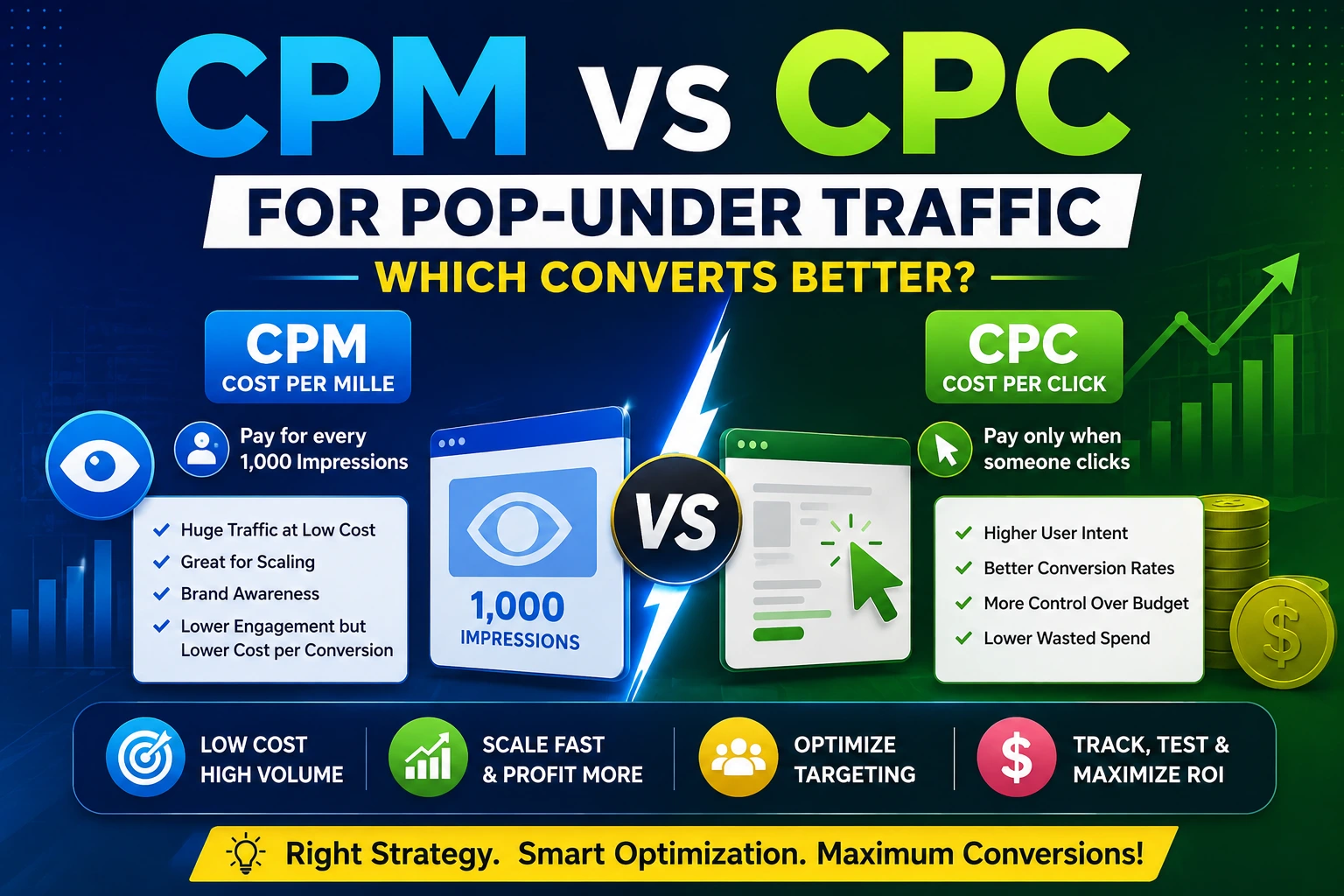
COST PER MILLECPM stands for Cost Per Mille — “mille” simply means one thousand. With CPM advertising, you pay for every 1,000 ad impressions, regardless of whether anyone clicks.
That means you’re paying $0.40 for every thousand impressions served — and if you want to model this against your own budget before committing spend, a cost per impression calculator makes it easy to test different budget-and-volume combinations.
02What is CPC?
COST PER CLICKCPC stands for Cost Per Click. Instead of paying for impressions, you only pay when someone actually clicks your ad.
03What is pop-under traffic?
Pop-under traffic is a form of online advertising where a webpage opens in a new browser window or tab behind the user’s current window. Unlike pop-ups, which interrupt immediately, pop-unders stay hidden until the visitor closes or minimizes the active tab.
Because they sit in the background, these ads usually see lower immediate engagement — but they can generate very large volumes of inexpensive traffic.

04How pop-under traffic works
A visitor lands on a publisher’s website.
The ad network opens the advertiser’s landing page in a background tab.
The visitor keeps browsing as normal, unaware of the new tab at first.
Later, they notice the background tab and may click into it.
If interested, they complete the desired action on the landing page.
Because users don’t intentionally click these ads, their conversion behavior looks very different from search or native advertising.
05Key differences between CPM and CPC
| Feature | CPM | CPC |
|---|---|---|
| Payment method | Per 1,000 impressions | Per click |
| Risk | Higher | Lower |
| Traffic volume | Very high | Moderate |
| Best for | Brand awareness and cheap traffic | Lead generation and sales |
| User intent | Low | Medium to high |
| Optimization | More important | Easier |
| Budget predictability | High | Depends on click volume |
06Which model converts better?
CPC usually wins on conversion rate — but CPM often wins on cost per conversion for pop-under campaigns specifically.
CPC traffic
Users actively click an advertisement, which means:
- Higher intent
- Better engagement
- Lower bounce rate
- Better conversion rates
This is exactly why search advertising typically outperforms display advertising on conversion rate.
CPM pop-under traffic
With CPM campaigns, users never intentionally click, and many simply ignore the new tab — only a percentage ever view the landing page.
Even so, CPM traffic is significantly cheaper, large volumes compensate for lower engagement, and skilled optimization can meaningfully bring down the overall cost per acquisition.
07Example comparison
Here’s what that trade-off looks like when the numbers are put side by side.
Pop-under CPM campaign
CPC campaign
Although the CPC visitors carried higher intent, the much lower CPM price produced a substantially lower cost per conversion in this example.
08Advantages of CPM and CPC
CPM
- Extremely cheap traffic — many pop-under networks price impressions below $1 CPM
- Excellent for scaling once a campaign proves profitable
- Ideal for brand awareness, even without an immediate click
- Better for testing multiple offers across large traffic volumes
CPC
- Higher user intent — people choose to click
- Lower wasted spend — you only pay for engaged visitors
- Easier performance tracking across CTR, conversion rate, and ROI
- Better for lead generation and qualified visitor volume
09When each model is the better choice
Choose CPM if…
- You’re buying pop-under traffic
- Your CPM rate is inexpensive
- You have a highly optimized landing page
- You’re promoting CPA offers
- You’re running brand-awareness campaigns
- You’re comfortable testing and optimizing
Choose CPC if…
- Every visitor matters
- You’re selling high-value products
- You’re generating leads
- You’re using search advertising
- Your budget is limited
- You want tighter control over spending
Don’t pick a model in isolation. A cheap CPM with a weak landing page will always lose to a pricier CPC with a page built to convert. Fix the page first, then choose the pricing model that fits your traffic volume goals.
10Industries that perform well with CPM pop-under traffic
Pop-under traffic has been used successfully across several verticals, including:
Success still depends on traffic quality, policy compliance, and ongoing optimization — the vertical alone won’t guarantee results.
11Tips to improve pop-under conversion rates
Optimize your landing page
A fast, mobile-friendly page with a clear call to action improves conversions dramatically.
Use geo targeting
Target countries that perform well for your offer instead of buying worldwide traffic.
Segment by device
Desktop and mobile users often behave very differently on the same offer.
Monitor frequency
Showing the same pop-under repeatedly to the same users reduces effectiveness over time.
Test multiple creatives
Different headlines, layouts, and offers can produce very different results.
Track every conversion
Use reliable analytics to identify which sources, devices, and locations actually perform.
12Common mistakes to avoid
- Choosing the cheapest traffic without considering quality
- Ignoring mobile optimization
- Sending traffic straight to a poorly designed landing page
- Failing to track conversions properly
- Running campaigns without A/B testing
- Not excluding low-performing locations or devices
- Judging performance too quickly without enough data
13FAQ
Is CPM better than CPC for pop-under traffic?+
For most pop-under campaigns, CPM tends to be the preferred pricing model because impressions are inexpensive and can deliver a lower cost per acquisition once optimized. That said, CPC traffic generally converts at a higher rate thanks to stronger user intent.
Why does CPC usually convert better?+
Users intentionally click CPC ads, which signals interest before they even land on your site. That tends to produce better engagement and higher conversion rates.
Is pop-under traffic still effective?+
Yes. Pop-under traffic remains effective for certain industries and affiliate campaigns when it’s paired with quality landing pages, proper targeting, and continuous optimization.
Which model is more cost-effective?+
It depends on execution. A well-optimized CPM campaign can outperform CPC on cost per acquisition, while CPC often delivers higher-quality visitors overall.
Can beginners use CPM campaigns?+
Yes — start with a small budget, watch results closely, and test different targeting options before scaling spend.
Conclusion
Choosing between CPM and CPC for pop-under traffic isn’t about finding a single “best” model — it depends on your objective.
If your priority is high-quality visitors and stronger conversion rates, CPC generally wins because users actively choose to click.
But if you’re running pop-under campaigns specifically, CPM is often the more practical, cost-effective option — low impression costs plus smart targeting and landing page optimization can produce excellent ROI despite lower engagement.
Rather than fixating on CPM vs. CPC alone, track cost per acquisition, conversion rate, ROI, bounce rate, and lifetime value. Those are the numbers that tell you what’s actually working.