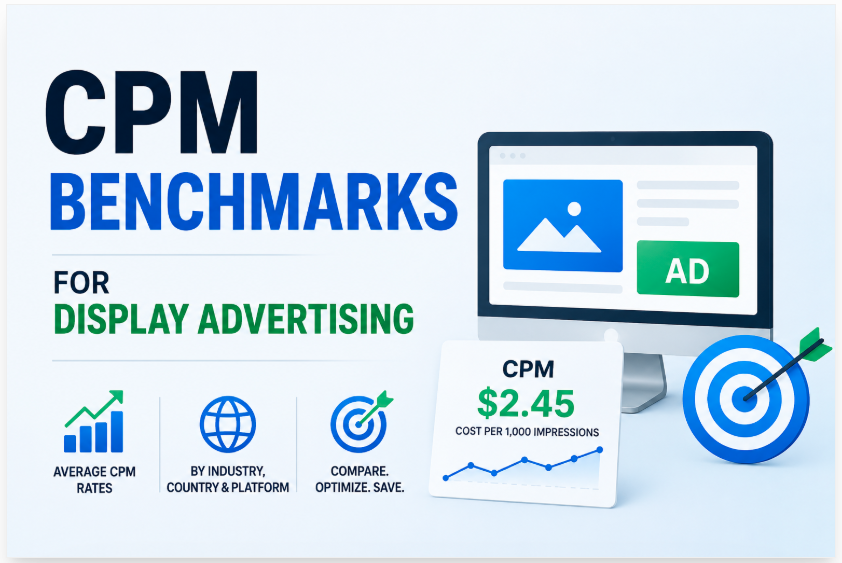
CPM Benchmarks for Display Advertising
Average CPM rates by industry, platform, country, and device, built for advertisers who want to know if their campaign costs are actually competitive.
Understanding CPM benchmarks for display advertising is essential for evaluating the performance of your digital advertising campaigns. Whether you’re running Google Display Network ads, programmatic campaigns, or banner advertisements, knowing what constitutes a good CPM helps you determine if you’re getting value for your advertising budget.
CPM (Cost Per Mille) represents the amount an advertiser pays for every 1,000 ad impressions. While a lower CPM generally means cheaper exposure, it doesn’t always translate into better campaign performance. Factors such as audience quality, targeting, competition, ad placement, industry, and geographic location all influence CPM rates. This guide explores average CPM benchmarks across industries, advertising platforms, countries, and devices, plus the factors that move them and how to optimize for better ROI.
What Is CPM?
CPM stands for Cost Per Mille, “mille” simply means one thousand in Latin. It measures the cost of delivering one thousand ad impressions, regardless of clicks or engagement.

Why CPM Benchmarks Matter
Knowing industry benchmarks allows advertisers to:
- Compare campaign performance against competitors
- Identify unusually high advertising costs
- Set realistic advertising budgets
- Estimate future campaign expenses
- Improve return on advertising investment (ROAS)
- Optimize bidding strategies
Without benchmarks, it’s difficult to determine whether your campaign is performing efficiently.
Average CPM Benchmarks by Platform
CPM varies significantly across platforms and industries. These ranges provide a useful reference point.
| Advertising Platform | Average CPM |
|---|---|
| Google Display Network | $2–$8 |
| Programmatic Display | $1–$6 |
| Native Advertising | $3–$12 |
| Premium Publisher Websites | $8–$30 |
| Retargeting Campaigns | $5–$15 |
Actual CPMs can run higher during competitive seasons or when targeting highly valuable audiences.
CPM Benchmarks by Industry
Industry competition has a major impact on CPM rates.
| Industry | Typical CPM Range |
|---|---|
| Retail & E-commerce | $2–$7 |
| Technology | $4–$10 |
| Finance | $8–$20 |
| Insurance | $10–$25 |
| Healthcare | $6–$15 |
| Education | $3–$8 |
| Travel | $4–$12 |
| Real Estate | $6–$14 |
| Automotive | $5–$11 |
| Entertainment | $2–$6 |
Highly competitive industries, finance and insurance especially, see higher CPMs due to increased advertiser demand for the same audience.
CPM Benchmarks by Country
Advertising costs also vary depending on geographic location and local purchasing power.
| Country | Typical CPM |
|---|---|
| United States | $5–$15 |
| Canada | $4–$12 |
| United Kingdom | $4–$10 |
| Australia | $5–$12 |
| Germany | $4–$10 |
| India | $0.50–$3 |
| Pakistan | $0.30–$2 |
| Brazil | $1–$4 |
| Philippines | $0.50–$2 |
| Indonesia | $0.40–$2 |
Developed markets generally carry higher CPMs because advertisers compete more aggressively for audiences with stronger purchasing power.
CPM Benchmarks by Device
Device type can influence advertising costs too.
| Device | Average CPM |
|---|---|
| Desktop | $3–$8 |
| Mobile | $2–$7 |
| Tablet | $3–$9 |
| Connected TV (CTV) | $15–$40 |
Connected TV campaigns command premium CPMs because of their high engagement and strong brand visibility.
What Is Considered a Good CPM?
A “good” CPM depends entirely on your campaign objective and industry, there’s no single universal number. Judge it against the benchmark for your own vertical and platform, not a generic average.
Rather than focusing only on CPM, evaluate it alongside click-through rate (CTR), conversion rate, cost per acquisition (CPA), and return on ad spend (ROAS).
Factors That Affect CPM
Audience Targeting
Highly targeted audiences usually cost more because they’re more valuable to advertisers.
Industry Competition
Insurance and finance see significantly higher CPMs due to intense bidding competition.
Ad Placement
Premium publisher websites typically charge higher CPMs than general display networks.
Geographic Location
Targeting users in countries with higher purchasing power generally costs more per thousand impressions.
Seasonality
Costs rise during major shopping events like Black Friday, Cyber Monday, and the holiday season.
Ad Quality
High-quality creatives with strong engagement improve efficiency and reduce effective cost over time.
How to Lower Your CPM
If your campaigns run higher-than-average CPM, consider these optimization strategies:
- Refine audience targeting
- Improve ad creative quality
- Test multiple banner sizes
- Exclude low-performing placements
- Optimize campaign frequency
- Improve relevance scores
- Schedule ads during cost-effective periods
- Monitor campaign performance regularly
Small, consistent improvements compound. A 10% CTR lift and a tighter placement list together can move cost-per-conversion far more than chasing the lowest CPM alone.
Common CPM Mistakes
Many advertisers make the mistake of evaluating campaigns based solely on CPM. Avoid these common errors:
- Prioritizing the lowest CPM instead of overall ROI
- Ignoring conversion metrics
- Using broad targeting without testing
- Failing to optimize creatives
- Not comparing performance across devices or locations
- Overlooking frequency caps
A low CPM is valuable only if it contributes to meaningful business outcomes.
Want to model your own campaign numbers against these benchmarks?
Try the CPM Calculator →Conclusion
Understanding CPM benchmarks for display advertising helps advertisers measure campaign efficiency, allocate budgets wisely, and identify opportunities for optimization. While average CPM rates differ by industry, platform, country, and audience, benchmarks provide valuable context for evaluating performance.
Remember that CPM is only one part of the equation. The most successful advertisers focus on overall campaign profitability by combining competitive CPMs with strong click-through rates, high conversion rates, and positive ROI. By monitoring benchmarks, testing creative variations, refining audience targeting, and continuously optimizing campaigns, you can maximize the value of every advertising dollar spent. For the underlying math behind these numbers, see How to Calculate CPM.