How to Calculate eCPM (With Formula & Examples)
A complete walkthrough of the eCPM formula, worked examples, and the conversions you’ll need to compare CPC, CPA, and flat-rate deals on one scale — plus our free eCPM Calculator for when you’d rather skip the manual math.
- What eCPM means and why it exists
- The eCPM formula, explained
- Step-by-step: how to calculate eCPM
- Converting CPC, CPA, and flat rates to eCPM
- eCPM vs. CPM vs. CPC vs. CPA
- Common mistakes when calculating eCPM
- Average eCPM benchmarks by ad format
- Use the free eCPM Calculator
- Frequently asked questions
Every ad deal is priced differently — some by CPM, some by the click, some by the action, some as a flat sponsorship fee — which makes it almost impossible to tell which one is actually the best deal. Knowing how to calculate eCPM (effective CPM) solves that by reducing any pricing model back to one comparable number: revenue per 1,000 impressions. This guide covers the exact formula, worked examples, and the conversions publishers and marketers use to standardize their numbers, along with our free eCPM Calculator | Calculate Effective Cost Per 1,000 Impressions for running the math instantly.
What eCPM Means
eCPM stands for effective Cost Per Mille — the revenue or cost per 1,000 impressions, calculated after the fact, no matter how the deal was actually billed. Whether a campaign was priced on CPM, CPC, CPA, or a flat fee, it can always be reduced to an eCPM once you know the total revenue (or spend) and total impressions.
Publishers use it to rank ad networks and demand sources that pay under completely different models. Advertisers use it in reverse, to see which channel is genuinely the cheapest per thousand views once every fee and click is factored in.
The eCPM Formula, Explained
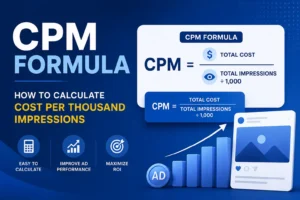
The formula is the same shape as CPM — the difference is what counts as “revenue”:
Rearranged, the same formula solves for the other two variables:
- Total Revenue = (eCPM ÷ 1,000) × Total Impressions — use this to project earnings from expected traffic.
- Total Impressions = (Total Revenue ÷ eCPM) × 1,000 — use this to estimate the traffic needed to hit a revenue target.
Step-by-Step: How to Calculate eCPM
Worked Example
A blog’s ad network paid out $450 across 90,000 impressions last month. Here’s how to calculate eCPM for that in three steps:
- 1Divide total revenue by total impressions — $450 ÷ 90,000 = 0.005
- 2Multiply the result by 1,000 — 0.005 × 1,000 = 5
- 3eCPM = $5.00 — five dollars earned for every 1,000 impressions
Converting CPC, CPA, and Flat Rates to eCPM
Most of the time you won’t have revenue and impressions handed to you directly — you’ll have a CPC or CPA rate and need to translate it into eCPM terms:
- From CPC: eCPM = CPC × CTR × 1,000 — a $0.75 CPC at a 1.2% CTR works out to a $9.00 eCPM.
- From CPA: eCPM = CPA × CVR × CTR × 1,000 — a $40 payout, 3% conversion rate, and 1.2% CTR works out to roughly $14.40 eCPM.
- From a flat sponsorship fee: treat the fee as “Total Revenue” and divide by the impressions it delivered, using the base formula.
These calculations get repetitive fast across multiple campaigns, which is exactly what our eCPM Calculator is built for — pick the inputs you have and it solves for eCPM instantly.
eCPM vs. CPM vs. CPC vs. CPA
| Metric | What It Measures | Best Used For |
|---|---|---|
| CPM | A quoted rate per 1,000 impressions, set upfront | Buying ad space at a fixed price |
| eCPM | Actual revenue per 1,000 impressions, calculated afterward | Comparing deals priced under different models |
| CPC | Cost per click | Traffic-driving campaigns |
| CPA | Cost per acquisition or conversion | Performance and direct-response campaigns |
CPM is what you’re quoted before a campaign runs. eCPM is what it actually worked out to once it’s over — which is why it’s the standard publishers use to rank ad networks against each other, regardless of how each one bills.
Common Mistakes When Calculating eCPM
Even once you know how to calculate eCPM, a few recurring slip-ups can quietly throw the number off:
- Comparing eCPM across mismatched impression counts without going back to total revenue first — eCPMs can’t simply be averaged, the same way raw CPMs can’t.
- Forgetting network revenue share. A network’s quoted eCPM sometimes excludes its own cut — confirm whether you’re looking at net or gross.
- Using stale CTR or CVR estimates when converting from CPC or CPA — outdated click and conversion rates can skew the result significantly.
- Mixing currencies or ad units (video vs. display) when benchmarking eCPM across sources.
- Treating a single day’s eCPM as representative. Daily eCPM swings with traffic quality and seasonality, so weekly or monthly averages are far more reliable.
Average eCPM Benchmarks by Ad Format
A general 2026 planning range across common ad formats, drawn from aggregated publisher and network reporting:
| Ad Format | Typical eCPM Range |
|---|---|
| Display banner | $0.50 – $3 |
| Native / in-feed | $2 – $8 |
| Interstitial (mobile app) | $4 – $12 |
| Rewarded video (mobile app) | $8 – $20 |
| Pre-roll video | $10 – $25 |
| Podcast / audio | $15 – $30 |
Actual eCPM depends heavily on audience geography, seasonality, and ad density — treat these as a sanity check, not a guarantee.
Use the Free eCPM Calculator
The formula is simple, but running it across multiple campaigns, networks, and ad formats adds up fast. We’ve already published a free, live eCPM Calculator that handles all three conversions covered in this guide — revenue-based, CPC-based, and CPA-based — with instant results as you type.
Enter your revenue, CPC, or CPA numbers and get your eCPM in one step — no manual math required.
Try the eCPM Calculator →Frequently Asked Questions
To calculate eCPM: (Total Revenue ÷ Total Impressions) × 1,000. Divide what you earned or spent by total impressions, then multiply by 1,000 — or use the eCPM Calculator to skip the manual steps.
CPM is a rate quoted before a campaign runs. eCPM is calculated afterward from actual revenue and impressions, which lets you compare deals priced under completely different models.
Yes. Multiply CPC by CTR (and by 1,000) to get eCPM, or multiply CPA by conversion rate and CTR (and by 1,000) for CPA-based deals.
Quoted CPM often assumes every impression sells at full rate. Real eCPM reflects unsold inventory, discounts, and revenue share, so it usually lands lower than the sticker price.
Yes — our eCPM Calculator is free, requires no signup, and supports revenue-based, CPC-based, and CPA-based calculations in one place.
Final Takeaway
Once you know how to calculate eCPM — Revenue ÷ Impressions × 1,000 — comparing any two ad deals becomes a matter of reducing them both to the same unit, no matter how each one was originally priced.
Do the math by hand when you want to understand what’s happening under the hood, and reach for the free eCPM Calculator whenever you just need the number.
Try the eCPM Calculator →