
How to Calculate CPM in Digital Marketing (With Formula & Examples)
A step-by-step breakdown of the CPM formula, worked examples, and the mistakes that throw off your ad budgeting math.
What You’ll Learn
Every media plan eventually comes down to one question: what will this campaign actually cost? Knowing how to calculate CPM in digital marketing is the fastest way to answer that, because CPM (cost per 1,000 impressions) is the pricing backbone behind most awareness and reach campaigns in digital marketing, from display banners to YouTube pre-roll to TikTok In-Feed ads. This guide walks through the exact formula, worked examples, and the reverse calculations you’ll need to turn a raw CPM number into a real budget.
1What Does CPM Mean in Digital Marketing?
CPM stands for Cost Per Mille — “mille” being Latin for thousand — and it represents the price an advertiser pays for every 1,000 times their ad is displayed, regardless of clicks or conversions. It’s the standard pricing unit across display advertising, video pre-roll, social feeds, and programmatic buys, which is exactly why learning how to calculate CPM in digital marketing is one of the first skills any media buyer or marketer needs.
CPM is an input metric, not an outcome metric — it tells you what you’re paying for visibility, not whether that visibility converted into anything. That’s why it’s almost always analyzed alongside CTR (click-through rate) and conversion rate rather than on its own.
2The CPM Formula, Explained
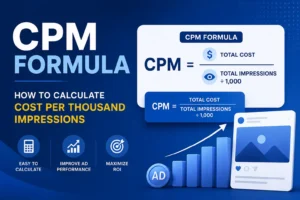
The core formula is simple once you see it written out:
You can rearrange this same formula to solve for either of the other two variables, which is where CPM becomes genuinely useful for budgeting rather than just reporting:
- Total Cost = (CPM ÷ 1,000) × Total Impressions — use this to estimate spend for a target reach.
- Total Impressions = (Total Cost ÷ CPM) × 1,000 — use this to estimate reach for a fixed budget.
3Step-by-Step: How to Calculate CPM in Digital Marketing
Worked Example
Say you ran a display campaign that spent $450 and generated 90,000 impressions. Here’s how to calculate CPM in digital marketing for that campaign in three steps:
- Step 1: Divide total cost by total impressions — $450 ÷ 90,000 = 0.005
- Step 2: Multiply the result by 1,000 — 0.005 × 1,000 = 5
- Step 3: Your CPM is $5.00 — meaning you paid $5 for every 1,000 times your ad was shown.
That’s the entire calculation. The formula stays identical whether you’re pricing a $50 test campaign or a $50,000 national rollout — only the inputs change.
Quick tip: Always confirm whether “impressions” in your ad platform’s report means served impressions (ad delivered) or viewable impressions (ad actually visible on screen) — mixing the two will quietly skew your CPM calculations.
4Reverse Calculations: Budget and Reach
Once you know a platform’s typical CPM, you can flip the formula to plan a budget before you spend a dollar. For example, if you’re working with an estimated CPM of $8 and want to reach 250,000 impressions:
- Total Cost = ($8 ÷ 1,000) × 250,000 = $2,000
Or if you have a fixed $1,000 budget and the same $8 CPM:
- Total Impressions = ($1,000 ÷ $8) × 1,000 = 125,000 impressions
This reverse calculation is what most media plans actually run on — you rarely start with impressions and cost already known; you start with a budget or a reach goal and work backward from an expected CPM.
5CPM vs. CPC vs. CPA vs. CTR
CPM is one of several pricing and performance metrics, and knowing when to lean on each one matters as much as knowing how to calculate CPM in digital marketing in the first place:
| Metric | What It Measures | Best Used For |
|---|---|---|
| CPM | Cost per 1,000 impressions | Brand awareness, reach campaigns |
| CPC | Cost per click | Traffic-driving, consideration campaigns |
| CPA | Cost per acquisition/conversion | Performance and direct-response campaigns |
| CTR | Click-through rate (clicks ÷ impressions) | Measuring creative and ad relevance |
CPM tells you what visibility costs; CPC and CPA tell you what results cost. A low CPM with a weak CTR can end up more expensive per outcome than a higher CPM with strong engagement, so these metrics are always best read together, not in isolation.
6Common Mistakes When Calculating CPM
- Mixing served and viewable impressions. Comparing a CPM built on served impressions against one built on viewable impressions will make campaigns look artificially cheaper or more expensive than they really are.
- Forgetting platform fees. Some reports show “media cost” CPM separately from all-in CPM that includes platform or agency fees — always check which one you’re looking at.
- Averaging CPMs incorrectly. You can’t simply average two CPM figures from campaigns with very different impression volumes; you need to recompute from total cost and total impressions instead.
- Ignoring currency and tax differences when comparing CPM across international campaigns run in different currencies or ad accounts.
- Treating CPM as a performance metric. A low CPM says nothing about whether the audience converted — pair it with CTR and conversion data before drawing conclusions.
7Average CPM Benchmarks by Platform
Once you understand the formula, it helps to have real numbers to plug in. Here’s a general 2026 planning range across major ad platforms:
| Platform | Typical CPM Range |
|---|---|
| Display / Programmatic | $2 – $10 |
| YouTube | $6 – $12 |
| TikTok | $4 – $13 |
| Meta (Facebook/Instagram) | $8 – $16 |
| $15 – $35 |
These ranges are a starting point for the reverse calculations covered earlier — plug the midpoint of your target platform’s range into the formula to get a rough budget before your first campaign even goes live.
8Use a Calculator Instead
The formula is simple, but running it repeatedly across multiple campaigns, platforms, and budget scenarios adds up fast — especially when you’re doing reverse calculations for a client proposal or an internal budget review.
Skip the manual math with our free cost per impression calculator — enter any two of the three values (cost, impressions, or CPM) and it instantly solves for the third.
Try the Free Calculator9Frequently Asked Questions
What is the basic formula to calculate CPM?
CPM = (Total Cost ÷ Total Impressions) × 1,000. Divide what you spent by how many impressions you received, then multiply by 1,000 to get your cost per thousand.
How do I calculate CPM if I only know my budget and target CPM?
Rearrange the formula: Total Impressions = (Total Cost ÷ CPM) × 1,000. This tells you how much reach a fixed budget will buy at a given CPM.
Is a lower CPM always better?
Not necessarily. CPM only measures the cost of visibility, not results — a low CPM paired with weak engagement can cost more per outcome than a higher CPM with strong CTR and conversion performance.
Does CPM include clicks or conversions?
No. CPM is based purely on impressions delivered, regardless of whether anyone clicked or converted. Clicks and conversions are captured separately through CPC and CPA.
✓Final Takeaway
Once you know how to calculate CPM in digital marketing, budgeting any awareness campaign becomes a matter of plugging numbers into one simple formula: Cost ÷ Impressions × 1,000. The same formula rearranges to solve for budget or reach, making it the single most useful equation in a media planner’s toolkit.
Just remember that CPM measures visibility, not results — always pair it with CTR, CPA, and conversion data before deciding whether a campaign is actually performing well.
Calculate Your CPM for FreeBenchmarks reflect aggregated 2026 industry reporting and platform auction data. Actual costs vary by account, audience, and campaign objective — use these figures as planning references, not guaranteed rates.