Whether you’re running Google Ads, Facebook Ads, Bing Ads, or any other pay-per-click advertising campaign, understanding how to calculate CPC is essential. CPC, or Cost Per Click, is one of the most important digital marketing metrics because it tells you exactly how much you are paying every time someone clicks on your advertisement. Use the authentic calculator to calculate CPC in a better way.
By tracking CPC, businesses can evaluate advertising performance, control marketing costs, and improve return on investment (ROI). In this guide, you’ll learn what CPC is, how to calculate it, practical examples, factors that affect CPC, and tips to reduce your advertising costs.
What Is CPC?
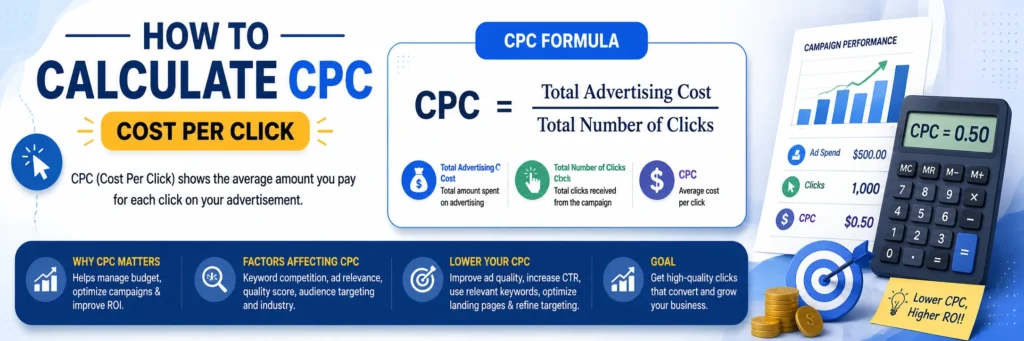
CPC stands for Cost Per Click. It is the average amount an advertiser pays each time a user clicks on their ad.
Unlike CPM (Cost Per Mille), where advertisers pay for every 1,000 impressions, CPC advertising charges only when someone actually clicks the ad.
For example, if you spend $100 on an advertising campaign and receive 200 clicks, your CPC indicates how much each click costs on average. If you understand what CPC is, then you can easily understand how to calculate CPC.
CPC Formula
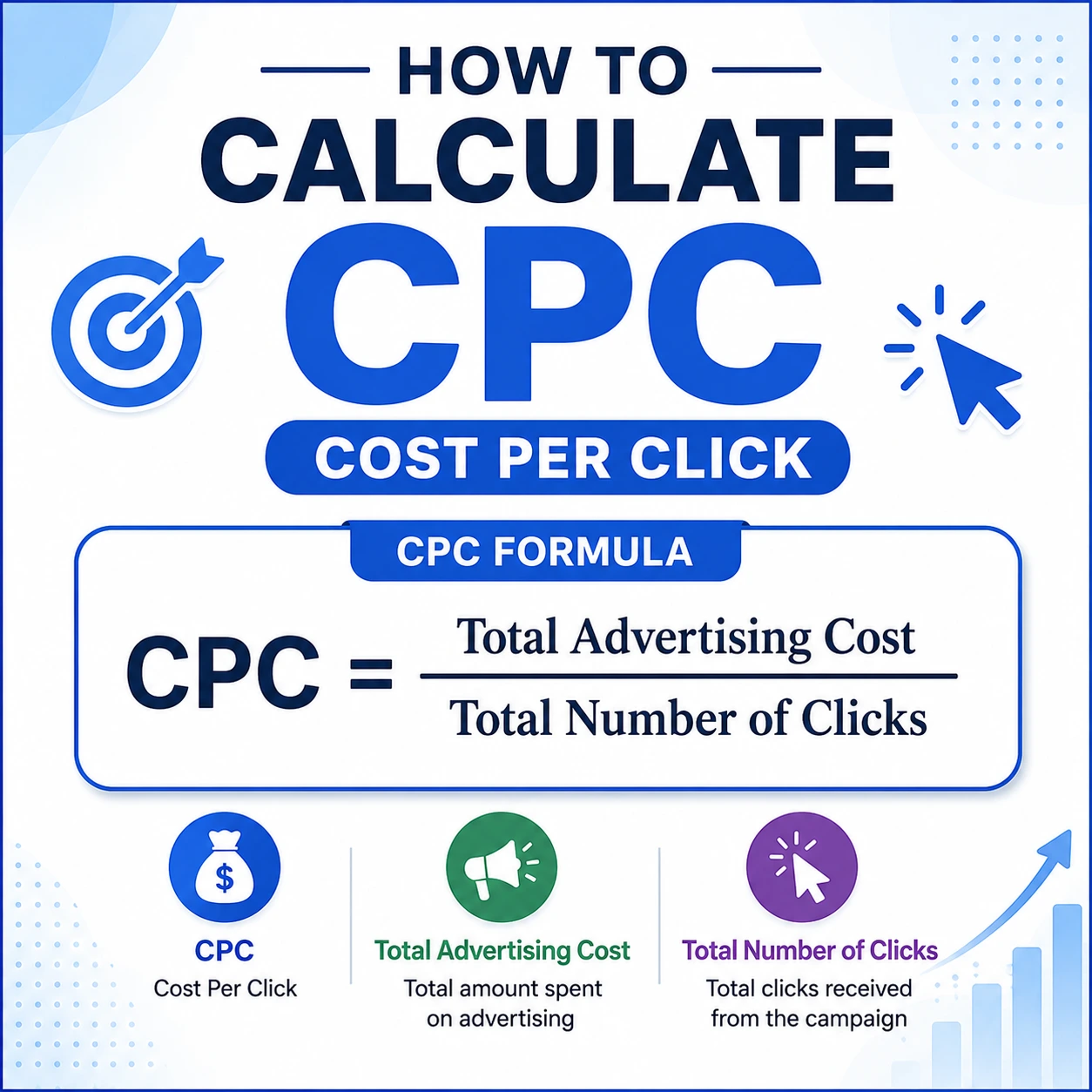
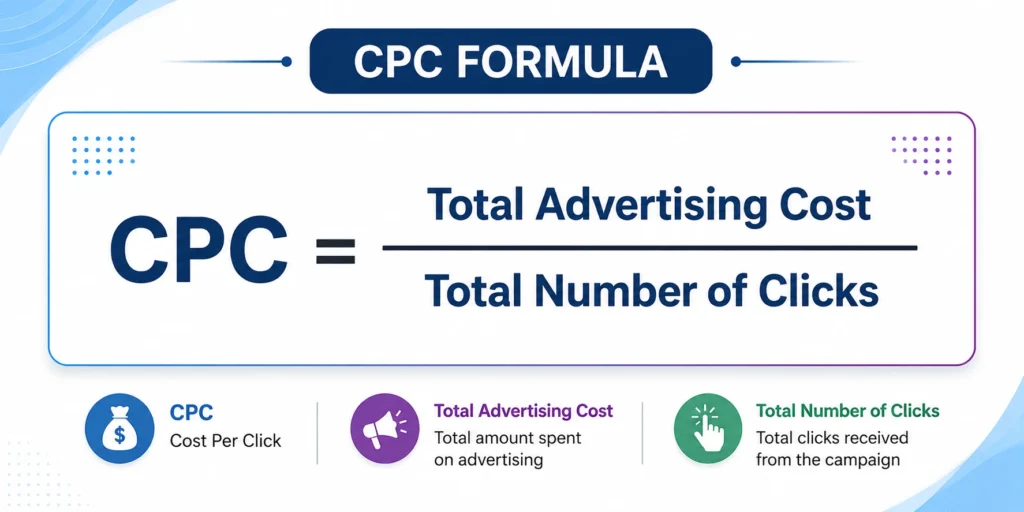
The formula used to calculate Cost Per Click (CPC) is:
CPC = Total Advertising Cost ÷ Total Number of Clicks
Or mathematically:
CPC = (Total Advertising Cost) / (Total Number of Clicks)
Where:
- CPC = Cost Per Click
- Total Advertising Cost = Total amount spent on advertising
- Total Number of Clicks = Total clicks received from the campaign
This formula helps advertisers determine the average cost of each click generated by an advertisement.
How to Calculate CPC Step by Step
Calculating CPC is straightforward.
Step 1: Determine Total Advertising Cost
Find the total amount spent on your advertising campaign.
Example:
- Advertising Cost = $500
Step 2: Find Total Clicks
Check your advertising dashboard to see how many clicks your ads received.
Example:
- Total Clicks = 1,000
Step 3: Apply the CPC Formula
- CPC = Total Advertising Cost ÷ Total Number of Clicks
- CPC = $500 ÷ 1,000
Step 4: Calculate the Result
- CPC = $0.50
This means you paid 50 cents for every click on your advertisement.
CPC Calculation Examples
Example 1: Small Business Campaign
Advertising Cost: $50
Total Clicks: 100
CPC = $50 ÷ 100
CPC = $0.50
Example 2: Google Ads Campaign
Advertising Cost: $1,200
Total Clicks: 2,000
CPC = $1,200 ÷ 2,000
CPC = $0.60
Example 3: Facebook Ads Campaign
Advertising Cost: $750
Total Clicks: 1,500
CPC = $750 ÷ 1,500
CPC = $0.50
Why CPC Is Important
Understanding CPC allows advertisers to make better marketing decisions.
Better Budget Management
CPC helps you understand exactly how efficiently your advertising budget is being used.
Campaign Optimization
A lower CPC often means more traffic for the same advertising budget.
Improved ROI Tracking
Knowing your CPC helps determine whether your campaigns are generating profitable results.
Performance Comparison
You can compare different ads, keywords, audiences, and campaigns to identify what performs best.
CPC vs CPM
Many advertisers confuse CPC and CPM because both are common advertising metrics.
| Metric | Meaning | Payment Based On |
| CPC | Cost Per Click | Clicks |
| CPM | Cost Per Thousand Impressions | Impressions |
Use CPC When:
- Driving website traffic
- Generating leads
- Increasing sales
- Measuring engagement
Use CPM When:
- Building brand awareness
- Increasing reach
- Promoting visibility
- Running display campaigns
Factors That Affect CPC
Several factors influence your Cost Per Click.
Keyword Competition
Highly competitive keywords generally have higher CPC values.
Quality Score
Search engines reward relevant and high-quality ads with lower CPC costs.
Ad Relevance
Ads closely matching user intent tend to achieve lower costs.
Audience Targeting
Certain demographics and locations are more expensive to target than others.
Industry Competition
Industries such as insurance, legal services, and finance often have significantly higher CPC rates.
How to Lower Your CPC
Improve Ad Quality
Create compelling ad copy and strong calls-to-action.
Increase Click-Through Rate (CTR)
Higher CTR often leads to improved quality scores and lower CPC.
Use Relevant Keywords
Focus on keywords that closely match your products or services.
Optimize Landing Pages
A fast, relevant landing page can improve campaign performance and reduce costs.
Refine Targeting
Target users who are most likely to engage and convert.
Common CPC Mistakes to Avoid
Focusing Only on Cheap Clicks
A low CPC doesn’t necessarily mean a successful campaign if those visitors don’t convert.
Ignoring Conversion Rates
Always evaluate CPC alongside conversions and revenue.
Not Testing Ads
Regular A/B testing can help identify ads with better performance and lower costs.
Overlooking Quality Score
Poor-quality ads often result in higher CPC charges.
CPC Calculation Table
| Advertising Cost | Clicks | CPC |
| $100 | 200 | $0.50 |
| $250 | 500 | $0.50 |
| $500 | 1,000 | $0.50 |
| $1,000 | 2,000 | $0.50 |
| $2,500 | 5,000 | $0.50 |
Conclusion
Knowing how to calculate CPC is a fundamental skill for every digital marketer, business owner, and advertiser. The calculation itself is simple—divide your total advertising cost by the total number of clicks received. However, the insights CPC provides can significantly impact your advertising success.
A good CPC is not necessarily the lowest one. The ultimate goal is to generate high-quality clicks that lead to conversions, sales, and long-term business growth. By consistently monitoring CPC, improving ad relevance, optimizing landing pages, and refining audience targeting, advertisers can maximize the value of every advertising dollar spent.
Whether you’re managing a small campaign or a large-scale marketing strategy, understanding CPC will help you make smarter decisions, control costs, and achieve better results from your online advertising efforts.
Frequently Asked Questions (FAQs)
What does CPC mean?
CPC stands for Cost Per Click and represents the average amount paid for each click on an advertisement.
How do I calculate CPC?
Use the formula:
CPC = Total Advertising Cost ÷ Total Number of Clicks
What is a good CPC?
A good CPC depends on your industry, platform, competition, and campaign goals. Lower CPC values are generally preferred if conversions remain strong.
Is CPC better than CPM?
CPC is ideal for traffic and conversion campaigns, while CPM is typically better for brand awareness and reach-focused campaigns.
Can CPC be reduced?
Yes. Improving ad quality, increasing relevance, optimizing landing pages, and refining targeting can all help reduce CPC.
Why is my CPC so high?
High CPC often results from strong competition, poor quality scores, broad targeting, or expensive industry keywords.
Does CPC affect ROI?
Yes. CPC directly impacts advertising costs and can significantly influence campaign profitability and return on investment.
What is the difference between CPC and CTR?
CPC measures the cost of each click, while CTR (Click-Through Rate) measures the percentage of users who click on an ad after seeing it.