
Understanding how to calculate CTR is essential for anyone involved in digital marketing, online advertising, email campaigns, or content promotion. CTR, or Click-Through Rate, helps you measure how effectively your ads, links, and campaigns encourage users to take action.
While many marketers still manually calculate CTR using a formula, modern online tools make the process much faster and more accurate. If you regularly analyze campaign performance, using a CTR calculator can save valuable time and eliminate calculation errors.
In this guide, you’ll learn how to calculate CTR, understand what CTR means, see practical examples, and discover why using an online calculator is often the smarter choice.
What Is CTR?
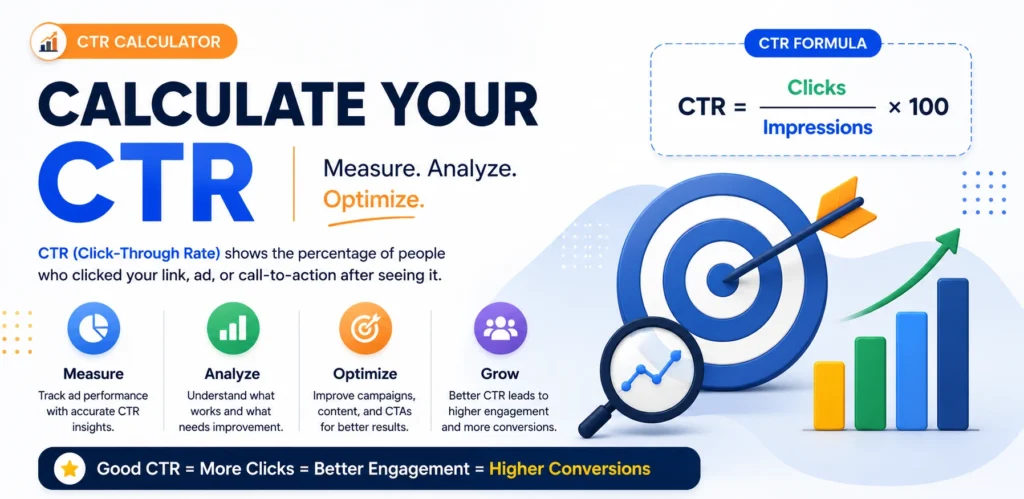
CTR stands for Click-Through Rate. It represents the percentage of people who clicked on your advertisement, link, email, or call-to-action after seeing it.
A higher CTR generally indicates that your content is relevant and engaging to your target audience.
CTR is commonly used in:
- Google Ads campaigns
- Social media advertising
- Email marketing
- Affiliate marketing
- Display advertising
- Search engine marketing
How to Calculate CTR
The standard method for how to calculate CTR is straightforward.
CTR=ClicksImpressions×100CTR=\frac{Clicks}{Impressions}\times100CTR=ImpressionsClicks×100
Formula Components
- Clicks = Number of times users clicked your ad or link
- Impressions = Number of times the ad or link was displayed
- 100 = Converts the result into a percentage
Example of How to Calculate CTR
Suppose your advertisement receives:
- 500 Clicks
- 20,000 Impressions
Applying the formula:
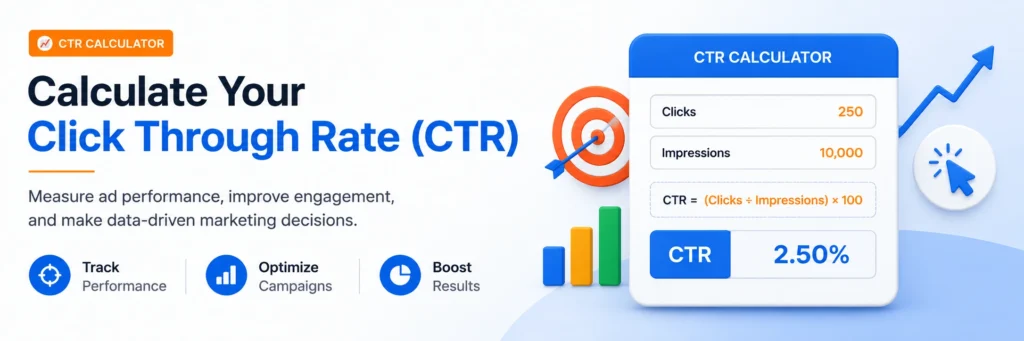
CTR = (500 ÷ 20,000) × 100
CTR = 2.5%
This means 2.5% of people who saw your advertisement clicked on it.
This example clearly demonstrates how to calculate CTR manually, but performing these calculations repeatedly can become time-consuming, especially when managing multiple campaigns.
Why Use a CTR Calculator Instead of the Formula?
Although learning how to calculate CTR is important, most marketers prefer using an online calculator because it offers several advantages:
Instant Results
No need to perform manual calculations or open spreadsheets.
Improved Accuracy
Even small calculation errors can affect campaign analysis. A calculator provides precise results every time.
Time Saving
Marketing professionals often analyze dozens of campaigns daily. Automation speeds up reporting.
Better Decision Making
Quick calculations allow faster optimization of ads, keywords, and landing pages.
Mobile-Friendly Access
You can calculate campaign performance from any device without additional software.
Step-by-Step Process Using Our CTR Calculator
Instead of manually applying formulas every time, you can simply:
- Enter the number of clicks.
- Enter the total impressions.
- Click the Calculate button.
- Instantly receive your CTR percentage.
This method is much faster than manually working through how to calculate CTR for every campaign.
What Is Considered a Good CTR?
A good CTR varies depending on the industry, platform, and campaign type.
Search Ads
Typically perform better because users are actively searching for information.
Display Ads
Generally have lower engagement rates because they are shown while users browse other content.
Email Campaigns
Performance depends on subject lines, audience quality, and content relevance.
Rather than comparing yourself with universal benchmarks, focus on improving your own historical performance over time.
Factors That Affect CTR
Several elements influence your click-through performance:
Ad Relevance
Relevant ads attract more clicks.
Compelling Headlines
Strong headlines increase user interest.
Audience Targeting
The right audience significantly improves engagement.
Visual Design
Well-designed creatives usually achieve higher click rates.
Call-to-Action
Clear instructions encourage users to click.
Common Mistakes When Calculating CTR
When learning how to calculate CTR, marketers often make these mistakes:
Confusing Clicks and Visits
Clicks and website sessions are not always identical.
Using Incorrect Impression Data
Always verify impression numbers from reliable reporting sources.
Ignoring Campaign Context
A lower CTR may still be profitable if conversions are strong.
Manual Calculation Errors
Small mathematical mistakes can lead to inaccurate reporting.
This is one reason many professionals rely on calculators rather than performing calculations manually.
CTR vs Conversion Rate
Many beginners confuse CTR with conversion rate.
| Metric | Measures |
| CTR | Percentage of impressions that generate clicks |
| Conversion Rate | Percentage of visitors who complete a desired action |
A campaign can have a high CTR but low conversions if the landing page fails to meet user expectations.
Benefits of Monitoring CTR Regularly
Tracking CTR helps marketers:
- Improve advertising performance
- Identify successful creatives
- Optimize keyword targeting
- Increase engagement rates
- Reduce wasted advertising spend
- Improve overall campaign effectiveness
Understanding how to calculate CTR is the first step toward making data-driven marketing decisions.
Conclusion
Learning how to calculate CTR helps marketers evaluate the effectiveness of advertising campaigns, emails, and promotional content. While the traditional formula remains important for understanding the concept, manually calculating CTR repeatedly can be inefficient and prone to errors.
For faster results, greater accuracy, and a better user experience, using an online CTR calculator is the preferred approach. Simply enter your clicks and impressions to get instant results, allowing you to focus on optimizing campaigns rather than performing calculations.
If you frequently analyze advertising performance, bookmark our CTR Calculator and use it whenever you need quick, reliable click-through rate calculations.
Frequently Asked Questions
Is CTR always expressed as a percentage?
Yes. CTR is reported as a percentage of clicks relative to impressions.
Can a high CTR guarantee sales?
No. CTR measures clicks, not purchases or conversions.
How often should CTR be monitored?
Most advertisers review CTR daily or weekly depending on campaign volume.
Is manual calculation necessary?
Not really. Once you understand how to calculate CTR, using a calculator is usually the faster and more efficient option.