How Are Profit Margins Calculated?
A complete guide for businesses and entrepreneurs covering the formulas, examples, and mistakes to avoid when measuring profitability.
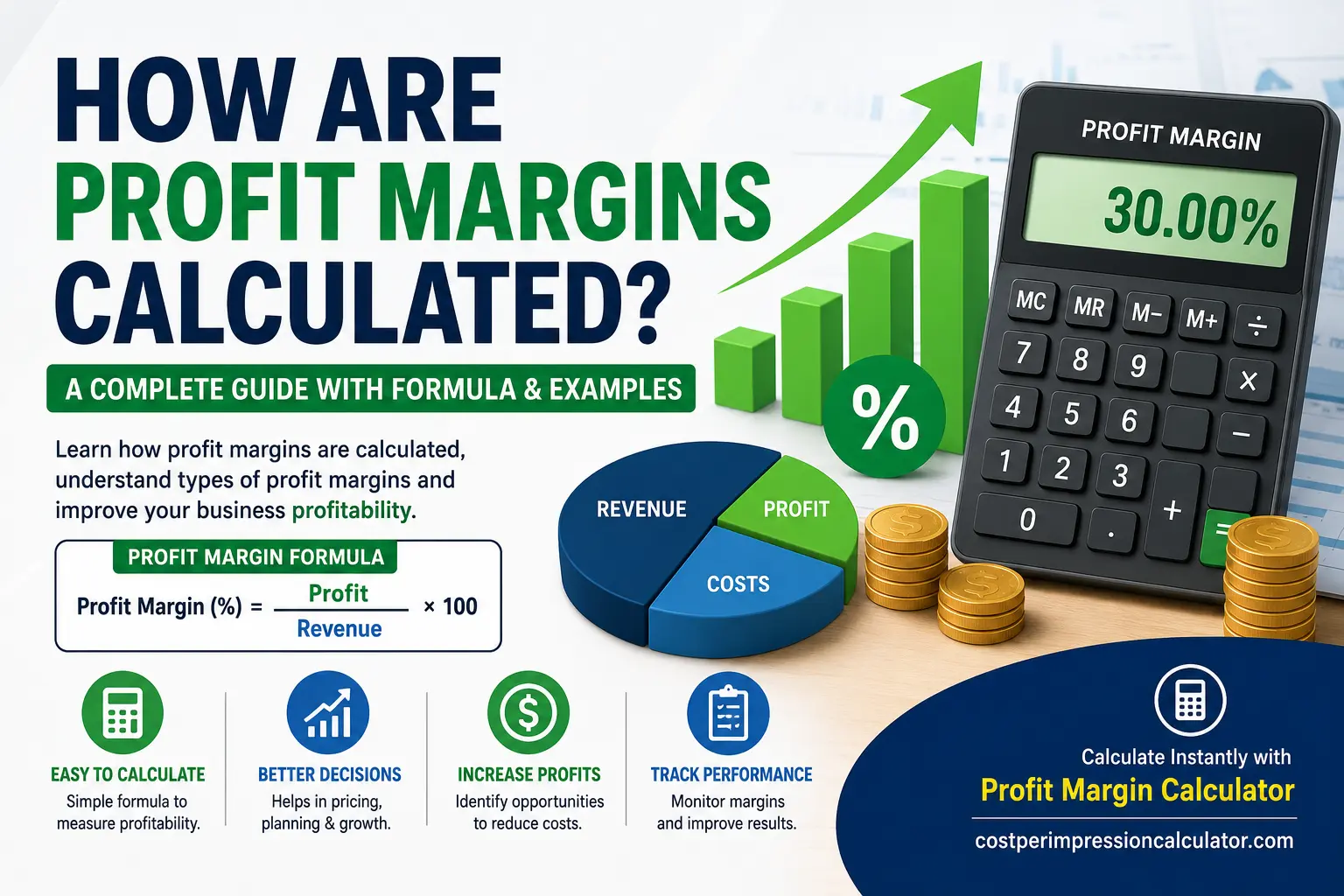
If you’ve ever wondered how are profit margins calculated, you’re not alone. Profit margin is one of the most important financial metrics for businesses of every size. Whether you own an online store, a restaurant, a manufacturing company, or work as a freelancer, understanding profit margins helps you evaluate financial health, make smarter pricing decisions, and increase profitability.
Instead of calculating everything manually, you can use our Profit Margin Calculator to instantly determine your profit margin, gross profit, and profitability percentage. In this comprehensive guide, we’ll explain how profit margins are calculated, the different types of profit margins, formulas, examples, common mistakes, and practical tips to improve your business performance.
What Is Profit Margin?
Profit margin is the percentage of revenue that remains after deducting costs. It tells you how much profit your business earns from every dollar or rupee in sales.
How Are Profit Margins Calculated?
Many business owners ask how are profit margins calculated because it provides a quick snapshot of business performance.

Revenue $5,000, Expenses $3,500. Profit = $5,000 − $3,500 = $1,500. Profit Margin = ($1,500 ÷ $5,000) × 100 = 30%. This means the business keeps 30 cents as profit from every dollar earned.
Why Profit Margin Matters
Profit margin is much more than just a percentage. It helps businesses:
- Measure profitability
- Compare performance over time
- Evaluate pricing strategies
- Attract investors
- Improve budgeting
- Reduce unnecessary costs
- Monitor financial growth
Without knowing your profit margin, it’s difficult to determine whether your business is truly making money.
Types of Profit Margins
Understanding the different types of profit margins is essential before learning how are profit margins calculated for various financial reports.
1. Gross Profit Margin
Measures profitability after subtracting the direct cost of producing goods.
2. Operating Profit Margin
Includes operating expenses such as salaries, rent, utilities, and marketing.
3. Net Profit Margin
The most comprehensive profitability measure, including taxes, interest, operating expenses, depreciation, and other costs.
Step-by-Step Guide to Calculate Profit Margin
Find total revenue
Example: Revenue = $12,000
Calculate total expenses
Inventory, salaries, rent, utilities, advertising, shipping, insurance. Example: $8,400
Calculate profit
$12,000 − $8,400 = $3,600
Apply the formula
($3,600 ÷ $12,000) × 100 = 30%
Real-Life Business Examples
| Business | Revenue | Costs | Profit | Margin |
|---|---|---|---|---|
| Retail Store | $50,000 | $35,000 | $15,000 | 30% |
| Restaurant | $80,000 | $64,000 | $16,000 | 20% |
| Freelance Graphic Designer | $4,000 | $800 | $3,200 | 80% |
Common Mistakes When Calculating Profit Margin
Even experienced business owners make errors. Common mistakes include:
- Ignoring hidden expenses
- Forgetting taxes
- Excluding shipping costs
- Mixing gross and net profit
- Using incorrect revenue figures
- Forgetting discounts and refunds
These mistakes can significantly affect your profitability calculations.
How to Improve Profit Margin
Once you understand how are profit margins calculated, the next step is improving them.
Increase Prices Carefully
Small price increases can significantly improve profitability.
Reduce Operating Costs
Lower utility bills, negotiate supplier prices, reduce waste.
Improve Productivity
Automation and efficient workflows reduce operating costs.
Sell Higher-Margin Products
Focus on products that generate better profits.
Reduce Returns
Improving product quality lowers return rates and increases profitability.
Profit Margin vs Markup
Many people confuse markup with profit margin. Profit margin is based on revenue, while markup is based on cost.
| Metric | Formula | Result (Cost $50, Price $75) |
|---|---|---|
| Markup | Profit ÷ Cost × 100 | 50% |
| Profit Margin | Profit ÷ Revenue × 100 | 33.33% |
These percentages are not the same, so it’s important to know which one you’re actually looking at.
Manual Calculation vs Calculator
Manual calculations are useful for learning but can become time-consuming for businesses handling multiple products or services. Instead, use our Profit Margin Calculator to instantly calculate:
- Profit
- Profit Margin
- Revenue
- Costs
- Profit Percentage
It eliminates mathematical errors and saves valuable time.
Industries That Use Profit Margin Calculations
Nearly every industry relies on profit margin analysis, regardless of size or sector.
Regardless of industry, knowing how are profit margins calculated helps owners make informed financial decisions.
Want your profit margin calculated instantly, no manual math required?
📊 Try the Profit Margin CalculatorFinal Thoughts
Understanding how are profit margins calculated is essential for anyone running a business or managing finances. By using the simple profit margin formula and reviewing your numbers regularly, you can make smarter pricing decisions, control expenses, and improve overall profitability.
Whether you’re managing a startup, an online store, or a large company, knowing how are profit margins calculated gives you a clearer picture of your financial performance. While manual calculations are useful for learning, using our Profit Margin Calculator provides a faster, more accurate way to measure profitability and make informed business decisions.