Share Incentive Plan Calculator: How to Work Out Your SIP Value
A complete guide to Free, Partnership, Matching, and Dividend shares under a Share Incentive Plan — plus how to calculate exactly what your plan is worth.
What You’ll Learn
- What is a Share Incentive Plan?
- Why use a SIP calculator
- How the calculator works
- SIP components and annual limits
- How the four share types flow into your plan
- Worked example
- The five-year holding period and tax relief
- Who is eligible
- SIP vs. other employee share schemes
- How share price movements affect your SIP value
- Common mistakes to avoid
- FAQs
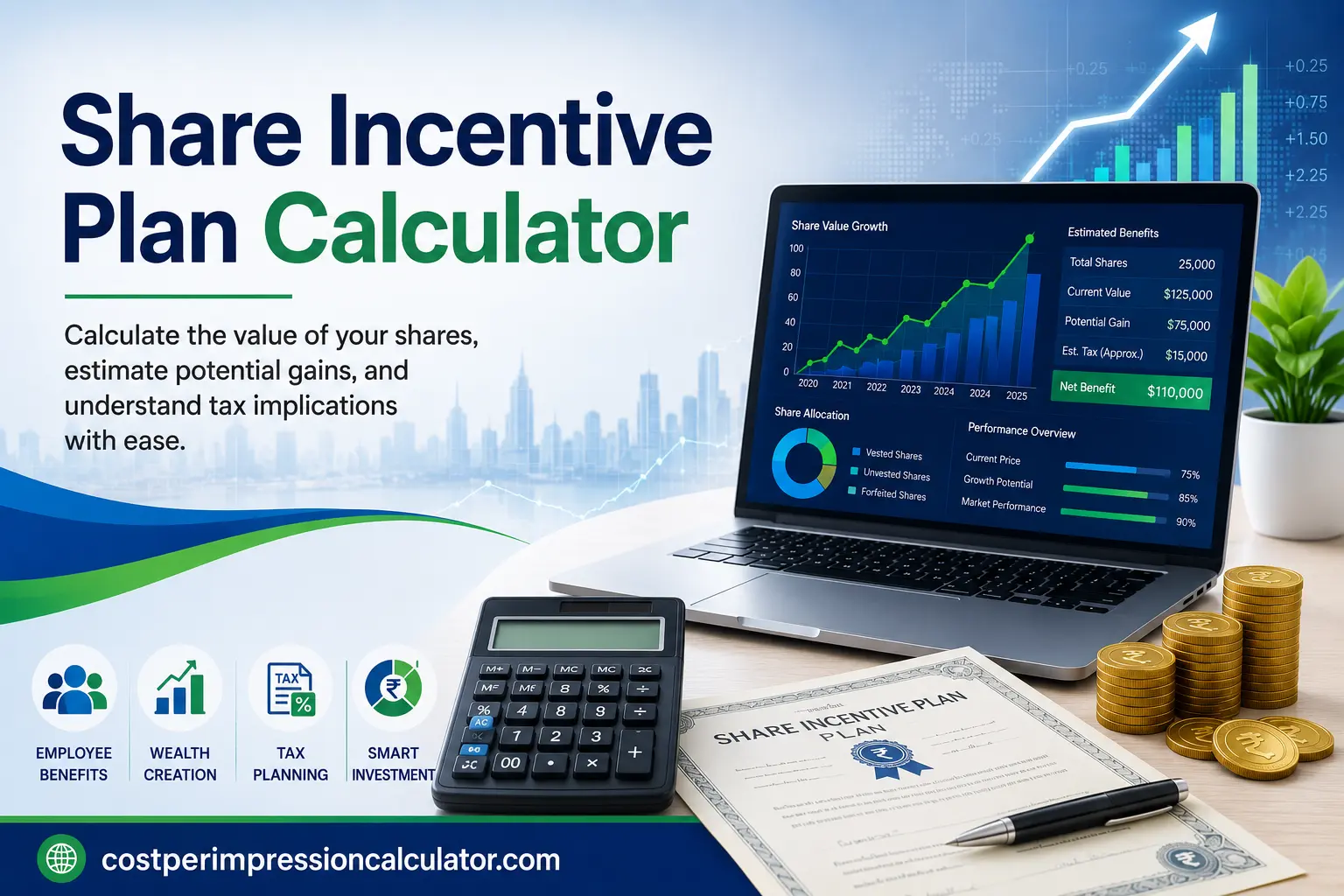
A Share Incentive Plan Calculator takes the guesswork out of one of the more confusing parts of employee share ownership: figuring out exactly how much your Free, Partnership, Matching, and Dividend shares are actually worth, and what you’d keep after tax if you left the plan early. This guide explains how a Share Incentive Plan works, walks through a full worked example, and shows you where to run your own numbers in seconds.
1What Is a Share Incentive Plan (SIP)?
A Share Incentive Plan is a tax-advantaged employee share scheme that lets companies award or sell shares to staff with meaningful income tax relief, provided the shares stay in an approved trust for a set period. It’s one of several approved all-employee share ownership models used by companies internationally, alongside option-based schemes that grant the right to buy shares at a future date rather than holding them directly.
Unlike option-based schemes, SIP shares are awarded or purchased directly and held in trust on your behalf — which is exactly why so many employees run the numbers before deciding how much of their salary, if any, to commit to Partnership shares.
SIPs were designed to encourage broad-based employee ownership rather than rewarding a small group of senior staff. To qualify for approval, a company must set up a trust, appoint trustees to hold shares on employees’ behalf, and offer the plan on materially the same terms to every eligible employee. This “all-employee” requirement is what separates a SIP from more selective, discretionary option schemes typically reserved for key hires at smaller, high-growth companies. Because the scheme spans four distinct share types — Free, Partnership, Matching, and Dividend — and each carries its own funding source, annual limit, and holding-period rule, most employees find it far easier to understand their total position through a calculator than by tracking four separate numbers across pay slips and annual statements.
2Why Use a Share Incentive Plan Calculator
SIPs combine up to four different share types, each with its own annual limit, funding source, and tax treatment. Working out your total position by hand — especially once matching ratios and share price movements are involved — gets complicated fast. A dedicated tool handles all of that in one place, letting you:
- Estimate the total value of Free, Partnership, and Matching shares you’d hold at the end of a tax year.
- See how different Partnership share contribution levels affect your take-home pay.
- Model what you’d keep after tax if you left the company before the five-year holding period.
- Compare scenarios side by side before deciding how much salary to commit.
3How the Calculator Works
Most tools follow the same basic logic: you enter your share price, how much you’re contributing to Partnership shares, your employer’s matching ratio, and any Free shares awarded, and the calculator returns your total share value and estimated tax position.
Ready to run your own numbers? Try the Share Incentive Plan Calculator to instantly see your total share value, matching contribution, and estimated tax position based on your own inputs.
Try the Free Calculator4SIP Components and Annual Limits
Before running the numbers yourself, it helps to know what each input actually represents:
| Share Type | How It’s Funded | Typical Annual Limit |
|---|---|---|
| Free Shares | Given by the employer at no cost | Up to a set value, e.g. 3,600 (currency depends on jurisdiction) |
| Partnership Shares | Bought by the employee from gross (pre-tax) salary | Up to a set value or a % of salary, whichever is lower |
| Matching Shares | Given by the employer per Partnership share bought | Up to 2 matching shares per 1 Partnership share |
| Dividend Shares | Bought using reinvested dividends from existing plan shares | Set by the employer’s plan rules |
Exact limits vary by employer plan and jurisdiction, so always check your own plan documentation for the figures that apply to you.
Combined, an employee using every element of the scheme to its full extent can build a substantial annual allocation, which is precisely why a Share Incentive Plan Calculator is so useful for seeing the full picture rather than tracking four separate figures manually.
5How the Four Share Types Flow Into Your Plan
6Worked Example
Scenario
Suppose your employer offers 1,500 in Free shares this plan year (using whatever currency your plan is denominated in), and you decide to contribute 1,200 in Partnership shares from your salary, with your employer matching at a 1:1 ratio. Running these figures through a Share Incentive Plan Calculator would produce something like this:
- Free shares: 1,500
- Partnership shares: 1,200
- Matching shares (1:1): 1,200
- Total share value awarded this year: 3,900
If the shares are held in the trust for the full five years, that entire amount — plus any growth in share price — can typically be withdrawn free of income tax.
7The Five-Year Holding Period and Tax Relief
The tax advantages of a SIP scale with how long shares stay in the trust:
| Time Held | Tax Treatment on Withdrawal |
|---|---|
| Under 3 years | Income tax generally due on market value at withdrawal |
| 3–5 years | Income tax generally due on the lower of original or current value |
| 5 years or more | Generally no income tax due on withdrawal |
Why this matters: Leaving your employer before the five-year mark can trigger an unexpected tax bill on shares you assumed were already yours tax-free — modelling this scenario is one of the most common reasons employees run these numbers before resigning or accepting a new role.
8Who Is Eligible?
SIPs must generally be offered to all employees subject to tax on employment income under the relevant plan rules, including part-time staff, though companies can set a minimum employment period of up to 18 months before someone becomes eligible. The scheme cannot give preferential treatment to directors or higher earners — it’s designed as a genuinely all-employee benefit, which is part of why it remains one of the most widely used share schemes among listed companies that offer it.
In practice, this means a graduate on their first day of eligibility and a long-serving senior manager both participate under the same rules, the same annual limits, and the same five-year holding requirement. Some companies do allow a qualifying period of employment before someone can join — commonly between three and eighteen months — but once that threshold is met, participation terms must be consistent across the workforce.
9SIP vs. Other Employee Share Schemes
SIPs are one of several tax-advantaged share schemes companies can offer, and each is built for a different purpose. Understanding how they differ helps explain why a SIP is usually the right fit for broad, company-wide participation rather than a small group of key employees.
| Scheme | Who It’s For | How Shares Are Acquired |
|---|---|---|
| SIP | All eligible employees | Free, purchased, matched, or dividend-funded shares |
| SAYE | All eligible employees | Savings contract funds a future share option purchase |
| EMI | Key employees at qualifying smaller companies | Discretionary share options |
| CSOP | Selected employees or directors | Discretionary share options up to a set value |
SAYE is the scheme most often compared to SIP, since both are all-employee arrangements. The key difference is that SAYE is built around a savings contract and a share option granted at a discount, exercised only if it’s financially worthwhile, while a SIP involves employees actually holding real shares — with real dividend rights and real exposure to price movement — from the moment they’re awarded or purchased.
10How Share Price Movements Affect Your SIP Value
Because SIP shares are real shares rather than options, their value moves with the company’s share price for as long as they’re held in the trust. This cuts both ways, and it’s worth understanding before deciding how much to commit through Partnership shares.
- If the share price rises after your shares are awarded, the increase is generally yours to keep tax-free once the five-year holding period is met — this is one of the more attractive upside features of a SIP compared to a straightforward cash bonus.
- If the share price falls, your Partnership shares are still worth less than what you paid, even though the tax relief on the original contribution still applies. Free and Matching shares carry less downside risk in this sense, since you didn’t pay for them directly.
- Dividend shares add a compounding element, since dividends paid on shares already held in the trust can be reinvested to buy further shares, gradually increasing your total position without any new salary contribution.
This is another area where running different share-price scenarios through a calculator is genuinely useful — a 10% swing in share price can meaningfully change your total position once matching shares and several years of dividend reinvestment are factored in.
11Common Mistakes to Avoid
- Over-committing to Partnership shares. Because contributions come out of gross salary, it’s easy to commit more than is comfortable month to month — remember the deduction happens before you see your take-home pay.
- Not accounting for the Lower Earnings Limit. Very large Partnership share contributions can, in some cases, reduce your qualifying earnings below the threshold used for certain statutory benefits — worth checking with payroll if you’re contributing near the maximum.
- Assuming all four share types follow the same holding-period clock. Free, Partnership, Matching, and Dividend shares awarded at different times each start their own five-year countdown, so a single “my shares are tax-free now” assumption can be wrong if awards happened on different dates.
- Forgetting about matching share forfeiture. Leaving before an employer’s forfeiture period — commonly up to three years — can mean losing Matching shares entirely, not just facing a tax charge on them.
- Ignoring currency or valuation timing for companies whose shares trade on an overseas exchange, where the value used for SIP purposes may be set at a specific valuation date rather than the date you check your portfolio.
12Frequently Asked Questions
It estimates the total value of your Free, Partnership, Matching, and Dividend shares based on your contributions and share price, and can also model the tax you’d owe if you withdrew shares before the five-year holding period.
There’s no statutory minimum, but individual company plans may set their own minimum Partnership share contribution, often a small amount per pay period.
Matching shares are often subject to a forfeiture period, commonly up to three years, if you leave before it ends. Free and Partnership shares already awarded are generally yours, though tax treatment on early withdrawal still applies.
No. Shares held in a SIP trust are separate from your ISA allowance and don’t count against it.
✓Final Takeaway
A Share Incentive Plan can meaningfully boost your total compensation with generous tax relief — but only if you understand how Free, Partnership, Matching, and Dividend shares combine, and how the five-year holding period affects what you actually keep.
Rather than tracking four separate figures by hand, run your own numbers through the Share Incentive Plan Calculator to see exactly what your plan is worth today.
Calculate Your SIP ValueThis article is for general informational purposes only and does not constitute tax or financial advice. SIP structures, limits, and tax treatment vary by jurisdiction and employer plan rules and are subject to change — confirm your specific position with your employer’s plan administrator or a qualified tax adviser.