How to Determine CPM: The Complete Guide for Smarter Ad Spending
A plain-English breakdown of the CPM formula, how to apply it to any campaign, and where your numbers should land compared to industry benchmarks.
If you’ve ever stared at a media plan wondering whether you’re overpaying for impressions, you’re not alone. Learning how to determine CPM is one of the fastest ways to take control of your advertising budget — and it’s simpler than most marketers assume once you see the formula and a worked example side by side.
What You’ll Learn ▾
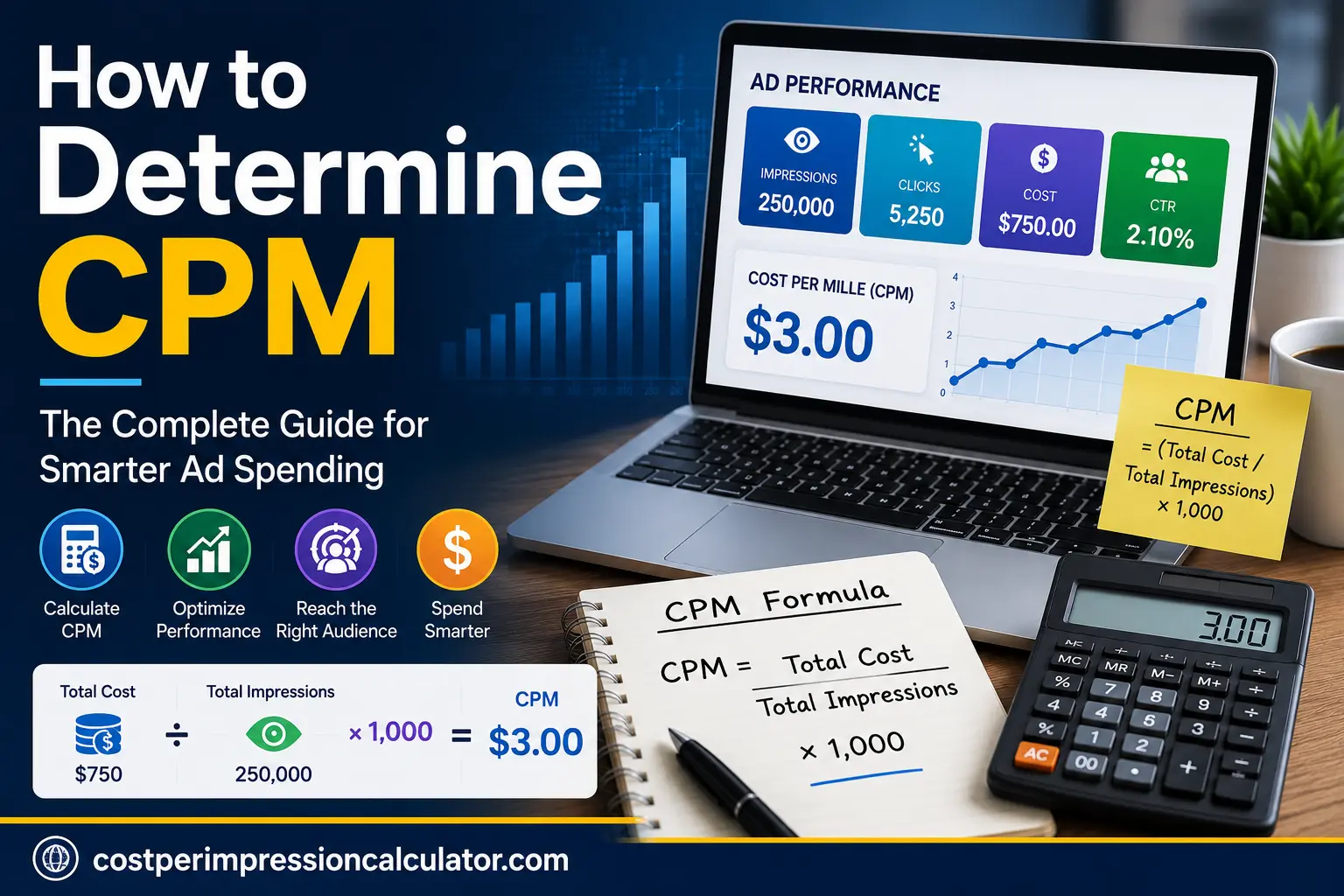
How do you determine CPM? Divide your total campaign cost by total impressions, then multiply by 1,000: CPM = (Cost ÷ Impressions) × 1,000. The result tells you exactly what you pay to reach 1,000 ad impressions, so you can compare channels, negotiate rates, and forecast budget with a single number.
What CPM Actually Measures
CPM, or Cost Per Mille (Latin for “cost per thousand”), is the pricing backbone of digital and traditional advertising alike. Whether you’re running display banners, social ads, streaming pre-rolls, or a print campaign, CPM tells you what you’re paying to put your message in front of 1,000 people. An “impression” is counted every time your ad is served or displayed, regardless of whether anyone interacts with it.
This makes CPM fundamentally different from CPC (cost per click) or CPA (cost per acquisition). CPM is a reach and awareness metric, not a direct-response one. Brands running awareness campaigns — product launches, rebrands, top-of-funnel storytelling — live and die by CPM because it’s the clearest way to compare efficiency across channels.
The Core CPM Formula
Here’s the exact formula for how to determine CPM — three inputs, one output.
The × 1,000 converts a per-impression cost into the industry-standard “per thousand” figure.
Prefer not to do the math by hand? The calculator at costperimpressioncalculator.com computes CPM instantly from your cost and impression numbers.
Step-by-Step: How to Determine CPM for Any Campaign
Knowing the formula is one thing; applying it correctly across real campaign data is another. Here’s the practical walkthrough.
Industry CPM Benchmarks
A CPM number only means something in context. Here’s how typical rates compare across major ad platforms:
| Platform | Typical CPM |
|---|---|
| Facebook / Instagram | $5 – $15 |
| Google Display Network | $2 – $10 |
| LinkedIn (B2B) | $30 – $65 |
| Connected TV / OTT | $20 – $45 |
| Programmatic Display | $1 – $5 |
Why Knowing How to Determine CPM Matters
Understanding this metric isn’t academic — it shapes three critical decisions:
- Channel comparison — CPM normalizes wildly different platforms into one comparable number.
- Negotiation leverage — knowing market-rate CPM means walking into publisher deals armed with data instead of guesses.
- Budget forecasting — once you know your average CPM, you can reverse-engineer exactly how much reach a given budget will buy.
Common Mistakes to Avoid
- Confusing impressions with reach — impressions count every serve; reach counts unique viewers only.
- Mixing time periods — cost and impression data must cover the exact same campaign window.
- Ignoring viewability — a served impression isn’t always a seen one; factor in typical viewability rates of 50–70%.
- Forgetting fees — platform, data, and verification fees can quietly inflate your effective CPM.
CPM vs. Effective CPM (eCPM)
Once you’re comfortable with how to determine CPM, it’s worth understanding its close cousin: eCPM, used mainly by publishers to normalize revenue from CPC, CPA, or flat-rate deals back into a CPM-equivalent figure.
Advertisers use CPM to plan spend; publishers use eCPM to evaluate earnings.
A Worked Example
Scenario
Say you spent $2,500 on a display campaign that generated 500,000 impressions. Applying the formula from Section 02:
CPM = ($2,500 ÷ 500,000) × 1,000 = $5.00
Your CPM is $5.00 — it costs you $5 every time your ad is shown 1,000 times. Against the benchmarks in Section 04, that would be a competitive rate for Facebook or Google Display, but on the high side for programmatic.
Skip the manual math
Plug in your cost and impressions and get an instant, accurate CPM — no spreadsheet formulas required.
Try the CPM Calculator →Frequently Asked Questions
Is a lower CPM always better?
Not necessarily. A low CPM paired with poor targeting can mean cheap, wasted impressions. Always weigh CPM against audience relevance.
How often should I calculate CPM?
Throughout an active campaign, not just at the end. Real-time monitoring catches inefficiencies early, while there’s still time to fix them.
Does CPM include agency or platform fees?
It depends on your reporting standard. Many teams track both a “media-only” CPM and a “fully loaded” CPM for full transparency.
Can I use CPM for non-digital advertising?
Yes. CPM originated in print and broadcast and applies to radio, out-of-home billboards, and direct mail wherever reach numbers exist.
Learning how to determine CPM transforms you from someone who just spends on ads into someone who understands exactly what that spend is buying. It’s a small formula — cost divided by impressions, times 1,000 — with an outsized impact on strategy, negotiation, and budget efficiency.
The next time you’re evaluating a media plan, calculate the CPM, compare it to the benchmarks in Section 04, and let the number guide your decisions rather than the total spend alone.