Conversion rate is one of the most important metrics in digital marketing. It tells you how effectively your website, landing page, advertisement, or marketing campaign turns visitors into customers or leads.
Whether you run an eCommerce store, SaaS business, blog, affiliate website, or advertising campaign, understanding how to calculate conversion rate helps you measure success and optimize your marketing efforts.
This guide explains the conversion rate formula, step-by-step calculations, real-life examples, industry benchmarks, factors affecting conversion rate, and strategies to improve it.
Calculate Your Conversion Rate Instantly
While calculating conversion rate manually is straightforward, it can become time-consuming when you’re analyzing multiple campaigns or large datasets.
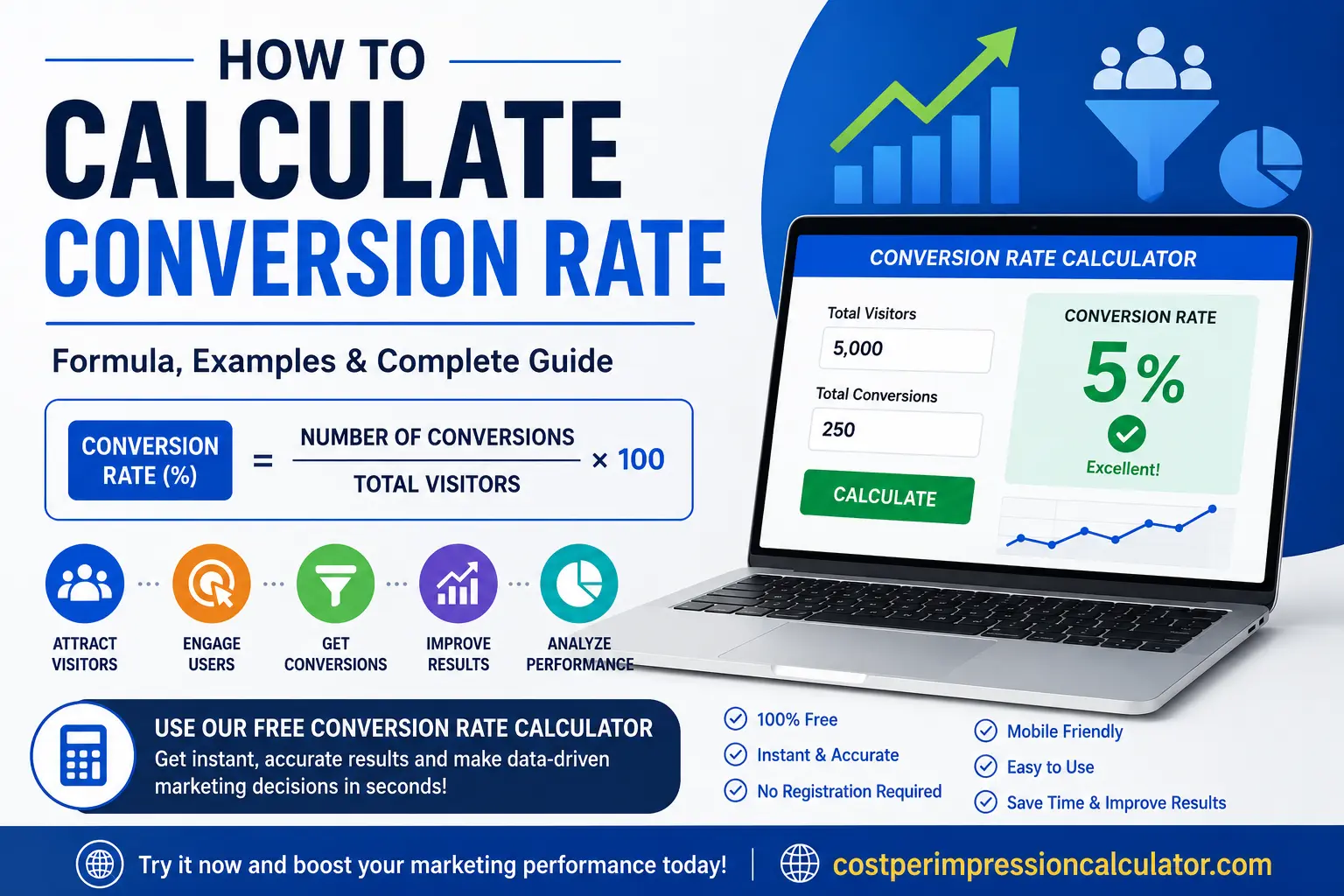
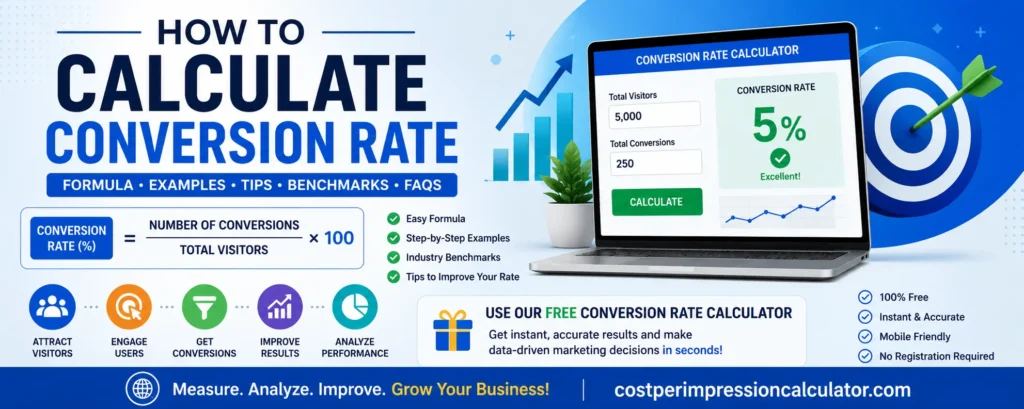
Our Conversion Rate Calculator eliminates the need for manual calculations. Simply enter your total visitors and conversions, and the tool instantly calculates your conversion rate with complete accuracy. Whether you’re a marketer, business owner, advertiser, or website manager, the calculator helps you save time and avoid calculation errors.
What Is Conversion Rate?
Conversion Rate (CR) is the percentage of visitors who complete a desired action out of the total number of visitors.
A conversion can be any valuable action, including:
- Purchasing a product
- Filling out a contact form
- Signing up for a newsletter
- Downloading an eBook
- Creating an account
- Registering for a webinar
- Installing a mobile app
- Requesting a quote
- Starting a free trial
- Clicking an affiliate offer
In simple words, conversion rate measures how successful your website or campaign is at persuading users to take action.
Conversion Rate Formula
The standard formula is:
Conversion Rate = (Number of Conversions ÷ Total Visitors) × 100
Where:
- Conversions = Number of completed desired actions
- Visitors = Total number of website visitors, users, or clicks (depending on your campaign)
The result is expressed as a percentage.
Skip the Manual Math
Although the conversion rate formula is easy to understand, there’s no need to calculate it manually every time.
With our free Conversion Rate Calculator, you only need to:
- Enter the total number of visitors.
- Enter the total number of conversions.
- Click Calculate.
- Instantly view your conversion rate as a percentage.
The calculator is especially useful when comparing multiple marketing campaigns, tracking monthly performance, or analyzing website traffic.
How to Calculate Conversion Rate Step by Step
Step 1: Count Your Total Visitors
Determine how many users visited your website, landing page, or advertisement during the selected period.
Example:
Total Visitors = 5,000
Step 2: Count the Number of Conversions
Find the number of users who completed the desired action.
Example:
Conversions = 250
Step 3: Apply the Formula
Conversion Rate = (250 ÷ 5,000) × 100
Conversion Rate = 0.05 × 100
Conversion Rate = 5%
This means that 5 out of every 100 visitors converted.
Conversion Rate Examples
Example 1: Online Store
Visitors: 8,000
Orders: 320
Calculation:
(320 ÷ 8,000) × 100
Conversion Rate = 4%
Example 2: Lead Generation Website
Visitors: 12,500
Leads Generated: 625
Calculation:
(625 ÷ 12,500) × 100
Conversion Rate = 5%
Example 3: Newsletter Signup
Visitors: 2,400
Subscribers: 180
Calculation:
(180 ÷ 2,400) × 100
Conversion Rate = 7.5%
Example 4: Mobile App Downloads
Landing Page Visitors: 15,000
Downloads: 900
Calculation:
(900 ÷ 15,000) × 100
Conversion Rate = 6%
Conversion Rate Calculation Table
| Visitors | Conversions | Conversion Rate |
| 1,000 | 20 | 2% |
| 2,500 | 75 | 3% |
| 5,000 | 250 | 5% |
| 10,000 | 600 | 6% |
| 25,000 | 2,000 | 8% |
Why Is Conversion Rate Important?
Conversion rate is one of the clearest indicators of marketing performance. A higher conversion rate means you’re getting more value from your existing traffic without necessarily increasing advertising costs.
Benefits include:
- Measures campaign effectiveness
- Identifies high-performing landing pages
- Improves return on investment (ROI)
- Reduces customer acquisition costs
- Supports data-driven decision-making
- Helps optimize marketing budgets
- Tracks business growth over time
Where Is Conversion Rate Used?
Conversion rate is widely used in:
- Digital marketing
- Search engine optimization (SEO)
- Google Ads campaigns
- Social media advertising
- Email marketing
- Affiliate marketing
- eCommerce stores
- SaaS businesses
- Mobile applications
- Lead generation websites
What Is a Good Conversion Rate?
A “good” conversion rate depends on your industry, audience, traffic source, and business model.
Typical benchmarks include:
| Industry | Average Conversion Rate |
| eCommerce | 2%–4% |
| SaaS | 3%–7% |
| Lead Generation | 5%–10% |
| Email Marketing | 2%–8% |
| Landing Pages | 5%–15% |
| Affiliate Marketing | 1%–5% |
High-performing websites often achieve conversion rates above these averages through continuous testing and optimization.
Factors That Affect Conversion Rate
Several elements can influence your conversion rate:
Website Speed
Fast-loading websites provide a better user experience and typically convert more visitors.
Mobile Optimization
A responsive, mobile-friendly website improves conversions across smartphones and tablets.
Page Design
A clean layout, intuitive navigation, and visually appealing design help users complete desired actions.
Call-to-Action (CTA)
Clear and compelling CTAs encourage users to take the next step.
Examples include:
- Buy Now
- Start Free Trial
- Get a Quote
- Download Now
- Subscribe Today
Product Pricing
Competitive pricing and transparent costs can significantly improve conversions.
Trust Signals
Displaying customer reviews, testimonials, security badges, guarantees, and clear contact information builds confidence.
Traffic Quality
Visitors who arrive through relevant keywords or targeted advertisements are more likely to convert than untargeted traffic.
How to Improve Your Conversion Rate
Improving your conversion rate often delivers better results than simply increasing traffic.
Consider these proven strategies:
- Optimize landing pages
- Improve page loading speed
- Simplify checkout or signup forms
- Use stronger calls-to-action
- Add customer testimonials
- Include trust badges and secure payment icons
- Optimize for mobile devices
- Use high-quality images and videos
- Personalize content for your audience
- Conduct A/B testing
- Reduce unnecessary form fields
- Offer free shipping or discounts when appropriate
Common Conversion Rate Calculation Mistakes
Avoid these common errors:
Using Page Views Instead of Visitors
Conversion rate should generally use unique visitors or sessions—not page views.
Counting Duplicate Conversions Incorrectly
Ensure your analytics platform accurately tracks completed conversions without duplication.
Comparing Different Time Periods
Use the same reporting period when comparing campaigns or websites.
Ignoring Conversion Goals
Clearly define what counts as a conversion before calculating the rate.
Conversion Rate vs Click-Through Rate (CTR)
| Metric | Measures | Best Used For |
| Conversion Rate | Percentage of visitors who complete a desired action | Measuring business results |
| Click-Through Rate (CTR) | Percentage of users who click an ad or link | Measuring ad engagement |
CTR tells you whether people click your ads, while conversion rate tells you whether those clicks result in meaningful actions.
Conversion Rate vs Bounce Rate
| Metric | Measures |
| Conversion Rate | Visitors who complete a desired action |
| Bounce Rate | Visitors who leave without interacting |
A high bounce rate often indicates issues with page relevance, speed, or user experience, which can negatively impact conversion rates.
Advantages of Tracking Conversion Rate
- Easy to calculate
- Measures marketing effectiveness
- Supports better budgeting decisions
- Helps optimize advertising campaigns
- Improves website performance
- Increases return on investment
- Enables continuous performance tracking
Limitations of Conversion Rate
While conversion rate is an essential metric, it has some limitations:
- Doesn’t measure revenue or profit
- Doesn’t account for customer lifetime value
- Doesn’t indicate traffic quality on its own
- Can be influenced by small sample sizes
- Should be analyzed alongside metrics like bounce rate, average order value, cost per acquisition (CPA), and return on ad spend (ROAS)
Conclusion
Knowing how to calculate conversion rate is essential for measuring the success of your website and marketing campaigns. The formula is straightforward:
Conversion Rate = (Conversions ÷ Total Visitors) × 100
By regularly monitoring your conversion rate, you can identify opportunities to improve user experience, optimize marketing strategies, and maximize the return on your advertising investment. When combined with metrics such as CTR, CPA, ROAS, and bounce rate, conversion rate provides a clear picture of your overall marketing performance.
Frequently Asked Questions
What is the formula for conversion rate?
The formula is:
Conversion Rate = (Conversions ÷ Total Visitors) × 100
Why is conversion rate expressed as a percentage?
A percentage makes it easier to compare the effectiveness of different campaigns, websites, and traffic sources regardless of their size.
What counts as a conversion?
A conversion is any action that aligns with your business goals, such as a purchase, lead submission, account registration, newsletter signup, or app download.
Is a higher conversion rate always better?
Generally, yes. However, it’s important to ensure that increased conversions also contribute to profitability and long-term business goals.
How often should I calculate conversion rate?
Most businesses monitor conversion rates weekly or monthly, while high-traffic websites and active advertising campaigns may track them daily.
Can conversion rate be improved without increasing traffic?
Yes. Improving website usability, page speed, calls-to-action, trust signals, and user experience can significantly increase conversions from your existing visitors.