CPC vs CPM
When comparing cost per click vs cost per impression, start with what your ad spend buys. Cost per click (CPC) measures the average cost of one click. Cost per impression measures the average cost of one ad display. Advertisers commonly use CPM, the cost per 1,000 impressions, to compare the cost of getting their ads shown.
Cost Per Click vs Cost Per Impression at a Glance
| Metric | What it measures | Best for comparing |
|---|---|---|
| CPC | Cost of one ad click | Traffic costs |
| Cost per impression | Cost of one ad display | Cost per individual display |
| CPM | Cost of 1,000 ad displays | Exposure costs across campaigns |
◆ Key distinction
When you compare cost per click vs cost per impression, use CPC to measure the price of a response and CPM to measure the price of delivery. An ad can have both metrics in the same report.
One person can generate several impressions by seeing your ad repeatedly. If your goal is to introduce your brand to new people, check unique reach and frequency alongside CPM.
On platforms that offer CPC bidding, the click is the billing event. In reports, you can also calculate average CPC for an impression-based campaign if it generated clicks. See Wikipedia’s overview of cost per click and pay-per-click advertising.
How to Calculate CPC, Cost Per Impression and CPM
Suppose you spend $100 on an ad that generates 20,000 impressions and 200 clicks. Use the same date range for all three numbers when calculating cost per click vs cost per impression.
Cost per click
CPC = Ad spend ÷ clicks
$100 ÷ 200 = $0.50 per click
Enter your ad spend and clicks in the CPC Calculator to work out your average cost per click.
Cost per impression and CPM
Cost per impression = Ad spend ÷ impressions
$100 ÷ 20,000 = $0.005 per impression
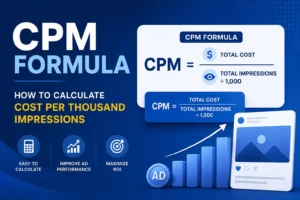
CPM = (Ad spend ÷ impressions) × 1,000
($100 ÷ 20,000) × 1,000 = $5.00 per 1,000 impressions
Enter your spend and impressions into the Cost Per Impression Calculator to get both figures.
Which Is Cheaper, CPC or CPM?
If you want traffic, click-through rate (CTR) determines how much each click effectively costs in a CPM campaign. At a 1% CTR, 1,000 impressions generate 10 clicks. If those impressions cost $5, the average click costs $0.50.
Here’s what a $100 budget at a $5 CPM buys at three different click-through rates.
| CTR | Impressions | Clicks | Effective CPC |
|---|---|---|---|
| 0.5% | 20,000 | 100 | $1.00 |
| 1.0% | 20,000 | 200 | $0.50 |
| 2.0% | 20,000 | 400 | $0.25 |
Find your break-even CTR
Use the formula below to compare a CPM offer with your expected average CPC. Enter both costs in the same currency. The result is a percentage.
Break-even CTR (%) = CPM ÷ (10 × average CPC)
For a $5 CPM offer and a $0.50 CPC option, the break-even CTR is 5 ÷ (10 × 0.50) = 1%. Above 1%, the CPM offer generates cheaper clicks. Below 1%, the CPC option generates cheaper clicks. At 1%, both cost $0.50 per click.
◆ Buying traffic on CPM?
In a cost per click vs cost per impression comparison, the break-even CTR gives you a target to test. Compare link clicks across both campaigns if your goal is landing-page traffic.
When to Use CPC or CPM
Use CPC to compare traffic costs
CPC helps when you want people to visit a product page, read an article, or open a registration form. If you ultimately need sales or leads, also track cost per acquisition (CPA). Spending $50 for 100 clicks and one sale gives you a $50 CPA. Spending the same $50 for 50 clicks and five sales gives you a $10 CPA, even though each click costs twice as much.
Use CPM to compare exposure costs
CPM helps when you’re introducing a brand, announcing a launch, or testing display placements for an awareness campaign. Check audience fit, reach and frequency before choosing a placement. Two campaigns with the same CPM can show the same number of ads while reaching very different numbers of people.
How to Compare Two Campaigns in Practice
A cost per click vs cost per impression comparison works best when the campaign reports use the same inputs. Start with this checklist before moving budget between placements.
- Choose your goal. For awareness, record impressions, reach and frequency. For traffic, record link clicks or landing-page visits. For sales or leads, record conversions.
- Match the reporting window. Pull spend, impressions and clicks from the same dates. When comparing CPA, check that the reports use the same attribution window.
- Calculate both metrics. Calculate CPM for each campaign and average CPC for any campaign that recorded clicks. You can then compare exposure and traffic costs side by side.
- Check what happened after the click. If the cheaper clicks produce fewer leads or sales, compare CPA to see which campaign used your budget more efficiently.
Frequently Asked Questions
Is cost per impression the same as CPM?
Cost per impression measures one ad display. CPM measures 1,000 ad displays. A $5 CPM equals $0.005 per impression.
How do you convert CPM to CPC?
Divide CPM by the clicks you expect per 1,000 impressions. At a 2% CTR, 1,000 impressions generate 20 clicks, so a $5 CPM works out to $0.25 per click.
Can a campaign have impressions and zero clicks?
Yes. You can calculate CPM as long as there are impressions. Average CPC is undefined when there are zero clicks.
Is a lower CPM always better?
A lower CPM buys more impressions for the same budget. Check who receives those impressions and how often they see the ad. For campaigns aimed at traffic or conversions, also compare effective CPC or CPA.
Conclusion
When comparing cost per click vs cost per impression, match the metric to your goal. Use CPC to compare traffic costs and CPM to compare exposure costs. If you’re buying impressions to drive traffic, estimate effective CPC using your expected CTR. For leads or sales, compare CPA before shifting your budget.