Whether you run Google Ads, Facebook Ads, or any other digital marketing campaign, measuring profitability is essential. One of the most important advertising metrics is Return on Ad Spend (ROAS). Understanding how to calculate ROAS helps businesses determine whether their advertising investments are generating enough revenue to justify the costs.
While the calculation itself is straightforward, manually calculating ROAS for multiple campaigns can become time-consuming and prone to errors. That is why many marketers now rely on online calculator tools to get instant and accurate results.
In this guide, you will learn how to calculate ROAS, understand the formula, review practical examples, and discover why using a ROAS calculator is often the smarter option.
What Is ROAS?
ROAS stands for Return on Ad Spend. It measures the amount of revenue generated for every dollar spent on advertising.
For example, if you spend $100 on ads and generate $500 in revenue, your ROAS indicates how effectively your advertising budget is performing.
Businesses use ROAS to:
- Measure campaign profitability
- Compare advertising channels
- Optimize marketing budgets
- Improve decision-making
- Identify high-performing campaigns
How to Calculate ROAS
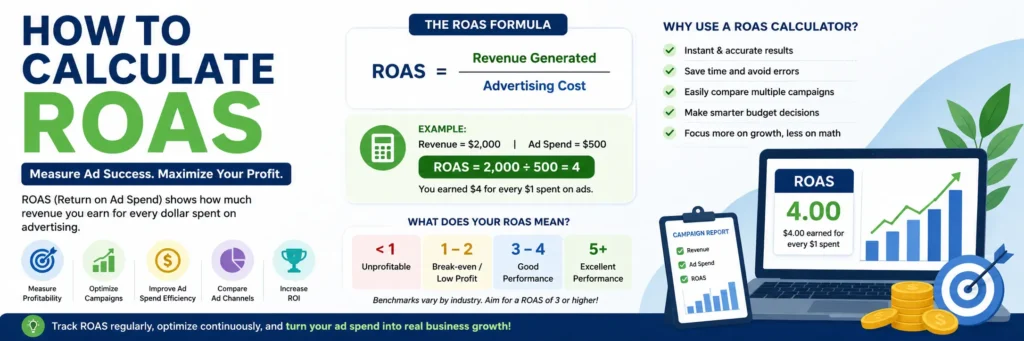
The standard formula for calculating ROAS is:
- ROAS = \frac{Revenue}{Advertising\ Cost}
This formula shows how much revenue is earned for each dollar spent on advertising.
Example 1
Suppose:
- Revenue Generated = $2,000
- Advertising Cost = $500
The calculation would be:
- ROAS = 2,000 ÷ 500 = 4
This means your campaign generated $4 in revenue for every $1 spent on advertising.
Step-by-Step Guide to Calculate ROAS
If you want to know how to calculate ROAS manually, follow these steps:
Step 1: Determine Total Revenue
Calculate the revenue directly generated by your advertising campaign.
Step 2: Identify Advertising Costs
Include all advertising expenses such as:
- Google Ads costs
- Facebook Ads spending
- Instagram advertising expenses
- Sponsored content fees
Step 3: Apply the Formula
Divide total revenue by total advertising cost.
Step 4: Interpret the Result
- ROAS below 1 = Losing money
- ROAS equal to 1 = Break-even point
- ROAS above 1 = Profitable campaign
The higher the ROAS, the more effective the advertising campaign.
Why Manual ROAS Calculations Can Be Difficult
Although the formula appears simple, manual calculations can become challenging when:
- Managing multiple campaigns
- Tracking different ad platforms
- Handling large datasets
- Monitoring daily performance
- Comparing advertising periods
Even a small calculation mistake can lead to inaccurate performance analysis and poor marketing decisions.
Why You Should Use a ROAS Calculator
Instead of spending time performing calculations manually, using a ROAS calculator provides several advantages.
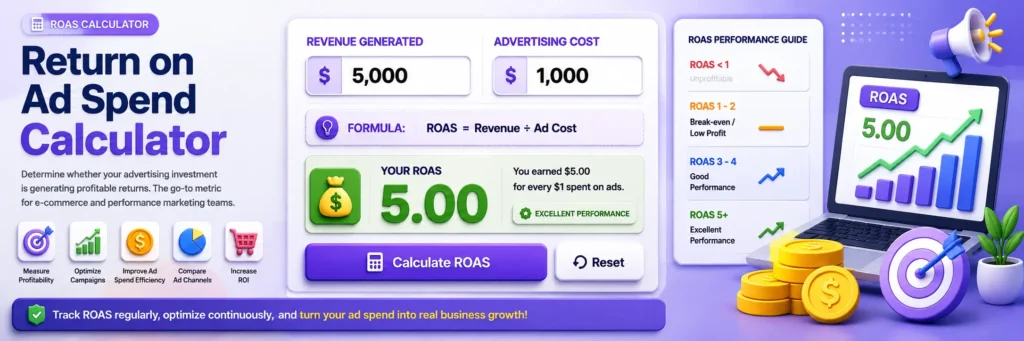
Instant Results
A calculator produces results within seconds, eliminating manual work.
Improved Accuracy
There is no risk of mathematical errors when values are entered correctly.
Time Savings
Marketers can focus on optimization rather than calculations.
Better Campaign Analysis
Quick calculations allow advertisers to compare multiple campaigns efficiently.
User-Friendly Experience
Most online tools require only revenue and advertising cost inputs to generate results immediately.
For businesses running frequent campaigns, a calculator is the fastest and most reliable solution.
Practical ROAS Examples
Example 2
- Advertising Cost: $250
- Revenue Generated: $1,250
- ROAS = 1,250 ÷ 250 = 5
This means every dollar spent generated $5 in revenue.
Example 3
- Advertising Cost: $1,000
- Revenue Generated: $3,500
- ROAS = 3,500 ÷ 1,000 = 3.5
This campaign generated $3.50 for every dollar invested.
What Is a Good ROAS?
A good ROAS depends on your industry, profit margins, and business goals.
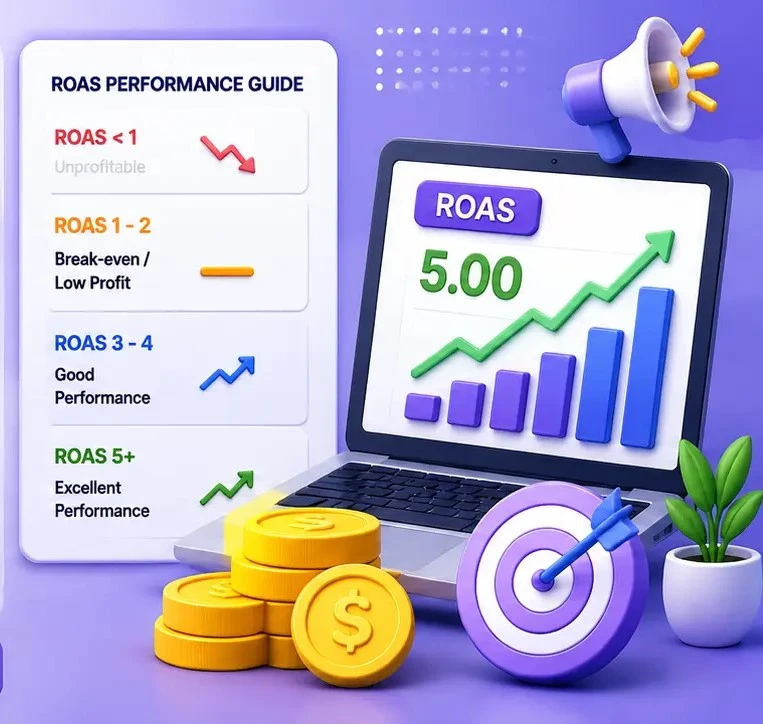
General benchmarks include:
| ROAS Value | Performance |
| Below 1 | Unprofitable |
| 1 to 2 | Break-even or low profit |
| 3 to 4 | Good performance |
| 5 or higher | Excellent performance |
Many businesses aim for a minimum ROAS of 4 to maintain healthy profitability.
Common Mistakes When Calculating ROAS
When learning how to calculate ROAS, avoid these common errors:
Ignoring Hidden Costs
Advertising-related expenses should be included whenever possible.
Using Incorrect Revenue Data
Only revenue directly attributable to the campaign should be counted.
Comparing Different Time Periods
Always compare campaigns using consistent date ranges.
Relying Solely on Manual Calculations
Repeated calculations increase the chances of mistakes and wasted time.
ROAS vs ROI
Many marketers confuse ROAS with Return on Investment (ROI).
- ROAS measures advertising efficiency only.
- ROI evaluates overall profitability by considering all business expenses.
Both metrics are useful, but ROAS provides a faster way to assess advertising performance.
Benefits of Tracking ROAS Regularly
Regular ROAS monitoring helps businesses:
- Improve advertising efficiency
- Increase profitability
- Reduce wasted spending
- Optimize campaign performance
- Allocate budgets more effectively
Using a dedicated calculator makes this process significantly easier and more accurate.
Conclusion
Understanding how to calculate ROAS is essential for evaluating the success of any advertising campaign. By dividing revenue by advertising cost, businesses can quickly determine how effectively their marketing budget is performing.
Although the formula is simple, manual calculations become inconvenient when managing multiple campaigns or large amounts of data. Instead of spending valuable time on repetitive calculations, using a ROAS calculator provides instant, accurate, and error-free results. For marketers, agencies, bloggers, and business owners, a calculator tool is the most efficient way to measure advertising performance and make smarter budget decisions.
Frequently Asked Questions (FAQs)
1. What does ROAS mean?
ROAS stands for Return on Ad Spend. It measures how much revenue you generate for every dollar spent on advertising.
2. How do I calculate ROAS quickly?
Use the following formula:
ROAS = Revenue ÷ Advertising Cost
For example, if your campaign generates $1,000 in revenue and costs $250 in advertising expenses, your ROAS would be 4. This means you earned $4 for every $1 spent on ads.
3. What is considered a good ROAS?
A good ROAS depends on your industry, operating costs, and profit margins. However, many businesses target a ROAS of 3:1 or higher, while a ROAS of 4:1 or 5:1 is often considered very strong.
4. Should I include taxes and fees in advertising cost?
Yes. To get a more accurate measurement of campaign performance, include all advertising-related expenses such as platform fees, agency charges, management fees, and applicable taxes.
5. Why use a ROAS calculator instead of calculating manually?
A ROAS calculator provides instant results, reduces the risk of human error, and saves valuable time. It is especially useful for marketers who manage multiple campaigns and need quick, reliable performance insights.