
How to Calculate Cost Per Impression (CPM): Formula, Examples & Fixes for Common Problems
If you’ve ever stared at an ad platform invoice and wondered whether you’re overpaying, the answer usually comes down to one number: cost per impression. Knowing how to calculate cost per impression lets you compare platforms fairly, catch pricing problems before they drain your budget, and set realistic targets for every campaign you run. This guide covers the full formula, worked examples, platform benchmarks, and, because the math is only half the battle, practical fixes for the CPM problems advertisers run into most often. By the end, you’ll know exactly how to calculate cost per impression for any campaign, spot when a rate is out of line, and negotiate a better deal.
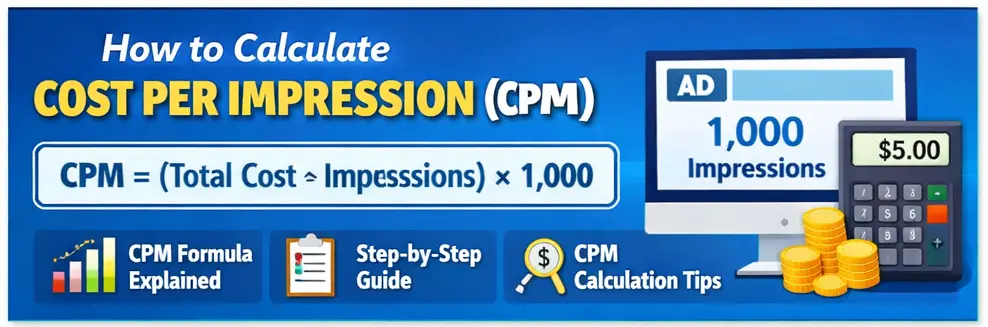
What You’ll Learn
- What Is Cost Per Impression (CPM)?
- Why Cost Per Impression Matters
- How to Calculate Cost Per Impression: The Formula
- How to Calculate Cost Per Impression Step by Step
- Worked Examples
- Reverse Calculation: Finding Total Cost
- CPM vs CPC vs CPA
- CPM Benchmarks by Platform and Industry
- Factors That Affect CPM
- Common Cost Per Impression Problems (and How to Fix Them)
- How to Negotiate a Lower CPM with Publishers
- Why Use a Calculator Instead of Manual Math
- Common Calculation Mistakes to Avoid
- FAQs
What Is Cost Per Impression (CPM)?
Cost per impression, commonly abbreviated as CPM (from the Latin mille, meaning “thousand”), measures how much an advertiser pays for every 1,000 times an ad is displayed. An impression counts the moment an ad loads on screen. It doesn’t require a click, a view duration, or any interaction at all, a standard the Interactive Advertising Bureau (IAB) helped formalize industry-wide.
Because it isolates cost from engagement, this pricing model is the standard wherever the goal is visibility rather than direct response, including:
- Display and banner advertising
- Social media ad placements
- Video pre-roll and mid-roll ads
- Programmatic and real-time bidding inventory
- Publisher ad-space pricing
The rest of this guide breaks down exactly how to calculate cost per impression step by step, with worked examples for each major ad format.
Why Cost Per Impression Matters
Understanding how to calculate cost per impression is the first step toward using CPM strategically instead of just reporting it. Cost per impression strips out engagement noise and tells you exactly what you’re paying for reach. That makes it useful for four core tasks:
Measuring brand exposure. For awareness campaigns, this rate is the cleanest way to track how efficiently a budget puts your brand in front of people.
Comparing ad platforms. Every network prices inventory differently. Calculating it on each one puts them on equal footing.
Forecasting budgets. Once you know your rate, you can estimate total spend for any target reach before a campaign launches.
Auditing performance. A rising CPM over time often signals shrinking inventory, tighter competition, or declining ad quality.
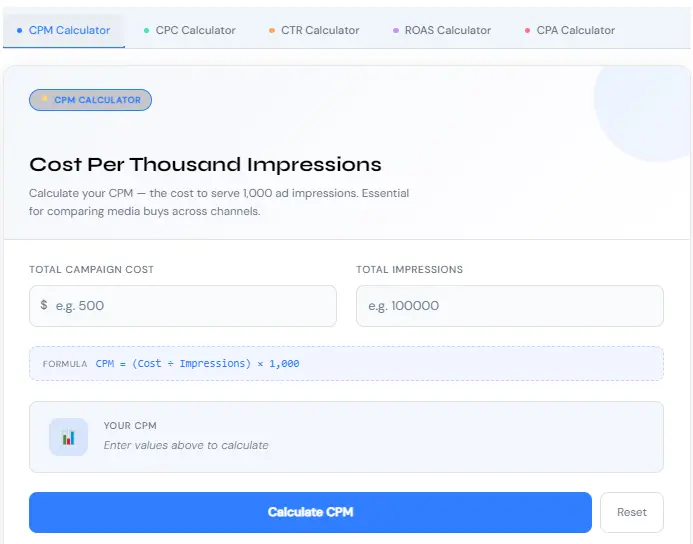
How to Calculate Cost Per Impression: The Formula
Here’s how to calculate cost per impression by hand, using just two numbers you already have: total ad spend and total impressions delivered.
Multiplying by 1,000 turns a tiny per-impression fraction into a readable, comparable rate, since a single impression on its own costs a fraction of a cent.
How to Calculate Cost Per Impression Step by Step
Once you understand the formula, here’s how to calculate cost per impression step by step so you never second-guess the math.
Step 1: Total your ad spend
Add up everything spent on the campaign. Example: $100.
Step 2: Count total impressions
Pull the impression count from your ad platform’s reporting. Example: 50,000.
Step 3: Divide cost by impressions
100 ÷ 50,000 = 0.002
Step 4: Multiply by 1,000
0.002 × 1,000 = 2
Step 5: Read the result
Your rate is $2 CPM: you paid $2 for every 1,000 times the ad was shown.
Worked Examples
These worked examples show how to calculate cost per impression in real scenarios advertisers run into every day.
Spend: $250 | Impressions: 100,000
(250 ÷ 100,000) × 1,000 = $2.50 CPM
Spend: $500 | Impressions: 80,000
(500 ÷ 80,000) × 1,000 = $6.25 CPM
Spend: $1,200 | Impressions: 300,000
(1,200 ÷ 300,000) × 1,000 = $4.00 CPM
| Ad Spend | Impressions | Cost Per Impression (CPM) |
|---|---|---|
| $50 | 10,000 | $5.00 |
| $100 | 50,000 | $2.00 |
| $250 | 100,000 | $2.50 |
| $500 | 80,000 | $6.25 |
| $1,000 | 500,000 | $2.00 |
Cost per impression moves with both spend and reach, so cost alone never tells the full story. Impressions delivered matter just as much.
Reverse Calculation: Finding Total Cost
When you already know your target cost per impression rate and want to estimate total spend for a given reach, flip the formula:
CPM: $5 | Target Impressions: 200,000
(5 × 200,000) ÷ 1,000 = $1,000 total spend
CPM vs CPC vs CPA
CPM is often mixed up with click- and conversion-based pricing. Here’s how the three compare:
| Metric | What It Measures | Best Suited For |
|---|---|---|
| CPM | Cost per 1,000 impressions | Brand visibility, reach |
| CPC | Cost per click | Traffic, lead generation |
| CPA | Cost per acquisition | Sales, signups, conversions |
None of these models is universally better: it depends on the campaign’s job. If you’re also running click-focused campaigns, it’s worth checking your rate with a CPC Calculator alongside this one, since the two metrics answer different questions about the same budget.
CPM Benchmarks by Platform and Industry
There’s no single “correct” CPM: rates shift by platform, industry, and targeting. These general ranges are a starting reference point, not a guarantee:
| Channel | Typical CPM Range | Notes |
|---|---|---|
| Display / banner ads | $1-$5 | Wide inventory keeps rates low |
| Social media feeds | $5-$12 | Varies heavily by audience niche |
| Video pre-roll | $10-$30 | Premium format, higher engagement |
| Finance / insurance / legal | $15-$40+ | High competition for conversions |
| Programmatic (open exchange) | $0.50-$3 | Lower cost, less placement control |
Factors That Affect CPM
Audience targeting. Narrow, high-value audiences raise the rate due to stronger competition for the same eyeballs.
Industry competition. Finance, insurance, and tech ads carry higher rates than lower-competition categories.
Ad placement. Premium, above-the-fold, or high-traffic placements command a price premium.
Device type. Mobile and desktop inventory are often priced differently on the same platform.
Geography. Advertising in higher-income regions generally pushes rates up.
Seasonality. Demand spikes around major shopping periods drive CPMs higher across the board.
Common Cost Per Impression Problems (and How to Fix Them)
The formula is the easy part. Most advertisers run into the same handful of real-world problems once campaigns are live. Here’s how to diagnose and fix each one.
My cost per impression is much higher than last month, and nothing in my targeting changed.
- Check for seasonal demand spikes: holidays and major sale periods push rates up platform-wide.
- Review your ad quality score; declining relevance scores quietly raise your rate.
- Confirm the audience pool hasn’t shrunk due to frequency caps or overlapping campaigns competing with yourself.
I can’t tell if a platform’s CPM is actually a good deal.
- Calculate the rate the same way across every platform, including fees, so the comparison is apples-to-apples.
- Weigh it against the benchmark ranges in Section 8 for your specific ad format and industry.
- Factor in downstream results: a slightly higher CPM on a better-matched audience can still be the cheaper option overall.
My impressions are cheap, but I’m not seeing clicks or conversions.
- A low rate often comes from broad, low-intent inventory: check placement reports for irrelevant sites or apps.
- Pair your CPM tracking with a CTR Calculator to see whether the ad is actually earning attention, not just showing up.
- Tighten targeting even if it raises CPM slightly: cheap reach that doesn’t convert is the more expensive option long-term.
My budget runs out before I hit my target reach.
- Use the reverse calculation in Section 6 to forecast the exact spend needed for your impression goal before launch.
- Spread budget with daily caps so it isn’t exhausted early in the flight by a temporary rate spike.
- Revisit targeting breadth: widening slightly can lower your average rate enough to close the gap.
Different reports show different impression counts for the same campaign.
- Check whether one report counts “viewable” impressions and another counts “served” impressions. They’re not the same number; see Google’s own definition of viewable CPM for how the two are measured differently.
- Standardize on a single source of truth (usually the platform actually billing you) when calculating this rate for budget decisions.
How to Negotiate a Lower CPM with Publishers
When buying direct from a publisher rather than an open exchange, your cost per impression is often negotiable. A few approaches that tend to work:
- Commit to volume. Publishers frequently discount rates for guaranteed impression minimums over a flight.
- Bundle placements. Combining a premium placement with remnant inventory can lower your blended rate.
- Negotiate flat-fee sponsorships for high-visibility spots instead of pure CPM, then calculate the effective rate afterward to check the value.
- Ask for makegoods. If delivered impressions fall short of the contracted number, publishers will often add bonus impressions rather than refund cash.
Why Use a Calculator Instead of Manual Math
The formula is simple, but running it by hand across dozens of line items invites errors and eats up time. A dedicated CPM calculator gives you:
- Instant, error-free results
- Faster budget planning and forecasting
- Easy side-by-side comparison across campaigns
- A cleaner way to sanity-check numbers from a media plan or invoice
Skip the manual math: plug your numbers into the CPM Calculator and get your rate instantly.
Use the CPM CalculatorCommon Calculation Mistakes to Avoid
Confusing impressions with clicks. An impression is a view, not an interaction. Mixing the two skews every downstream number.
Forgetting to multiply by 1,000. Skipping this step is the single most common calculation error.
Using incomplete cost data. Leaving out fees or agency markups understates the true rate.
Ignoring campaign goals. A CPM that looks “bad” in isolation may be perfectly reasonable for a premium, highly-targeted placement.
Final Takeaway
Cost per impression gives advertisers a fast, standardized way to measure and compare the price of visibility across any platform. Once you’re comfortable with the formula (spend divided by impressions, times 1,000), you can forecast budgets, benchmark platforms, negotiate with publishers, and spot the specific problem behind a rising rate before it drains your ad spend. Pair the formula with a calculator for day-to-day work, and use the underlying math to sanity-check every number that comes back.
Frequently Asked Questions
What does CPM stand for?
CPM stands for “cost per mille,” meaning cost per 1,000 impressions.
Is cost per impression better than CPC?
It depends on the campaign’s goal. CPM suits visibility and brand-awareness campaigns, while CPC is better suited to driving clicks and traffic.
Can I calculate cost per impression manually?
Yes. Divide total ad spend by total impressions, then multiply the result by 1,000.
Why does this metric matter for advertisers?
It gives advertisers a standardized way to measure advertising cost and campaign exposure, and to compare pricing across platforms.
What’s considered a low CPM?
It varies widely by industry and platform, but generally a lower CPM means cheaper audience reach, though it should always be weighed against audience quality.
Why did my CPM suddenly increase?
Usually seasonal demand, a shrinking audience pool, declining ad relevance, or increased competition in your targeting segment. See Section 10 for a full breakdown.
Can I negotiate CPM rates?
Yes, when buying directly from a publisher. Volume commitments, bundled placements, and flat-fee sponsorships are common ways to lower your effective rate.